
Opinion & Analysis
Launch monitors have changed the way tour players hit their drives

I keep track of the radar metrics on the PGA Tour each week, and so far this season I’ve started to see some noticeable differences in the radar data being produced by the field than I have in years past. So I decided to look at the Tour averages for each season since the Tour started to record the radar data back in 2007.
Here’s a chart showing those averages each season.
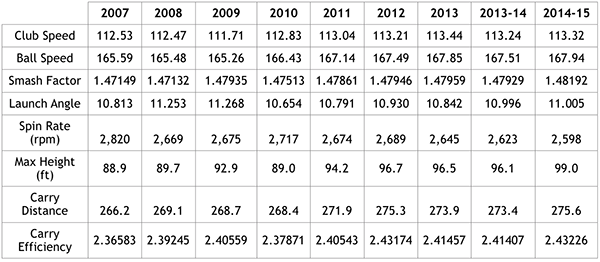
Click the chart to enlarge it.
To draw an even clearer picture, here’s a comparison between this season’s radar metrics and the inaugural season in 2007.
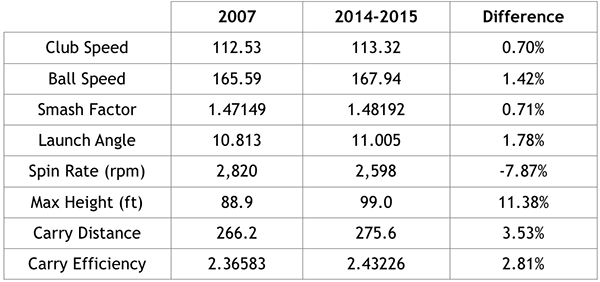
Click the chart to enlarge it.
While the club speed and ball speed have picked up, the larger differences are in the Max Height and Spin Rate metrics. The other two factors that have seen a marked change are Smash Factor and Carry Efficiency, which are calculated using the formulas below.
- Smash Factor = Ball Speed / Club Head Speed
- Carry Efficiency = Carry Distance / Club Speed
While the percentage difference between these two metrics is smaller than the other metrics, we have to remember that USGA rules have a certain allowable Smash Factor that is roughly 1.50. So there is a ceiling with regards to Smash Factor and the same goes for Carry Efficiency.
What this shows is the effect that launch monitors have had on PGA Tour swings, as well as the golf equipment industry, which has been producing metal woods that launch the ball slightly higher and with less spin in recent years. I can also conclude from the metrics that fewer players are hitting their driver with a severely downward attack angle (-4 degrees or steeper), because:
- Their launch angles are up.
- Their carry efficiency is up.
- Their max height is significantly up.
- Their spin rate is down.
According to Trackman, with all things being equal, the lower a golfer’s Spin Loft the higher the Smash Factor. Spin Loft is a measurement of a golfer’s dynamic loft, which is the amount of loft they deliver to the ball at the moment of maximum ball compression, minus a golfer’s angle of attack, as shown below.
- Spin Loft = Dynamic Loft – Attack Angle
So if Tour players are less steep with their attack angle and their dynamic loft is roughly the same, the Spin Loft has now decreased and that allows for a higher Smash Factor.
What is probably most interesting is that higher club-head speed players have resorted to more of an upward hit on the ball. In the past, the high club-speed players almost exclusively kept their launch low so they could keep the max height low and better control their drives. They would generally have a launch angle between 9 to 10 degrees with about 2,800 rpm of spin. Now, we see some of the higher club-head speed players on Tour with very high launch angles and low spin rates.
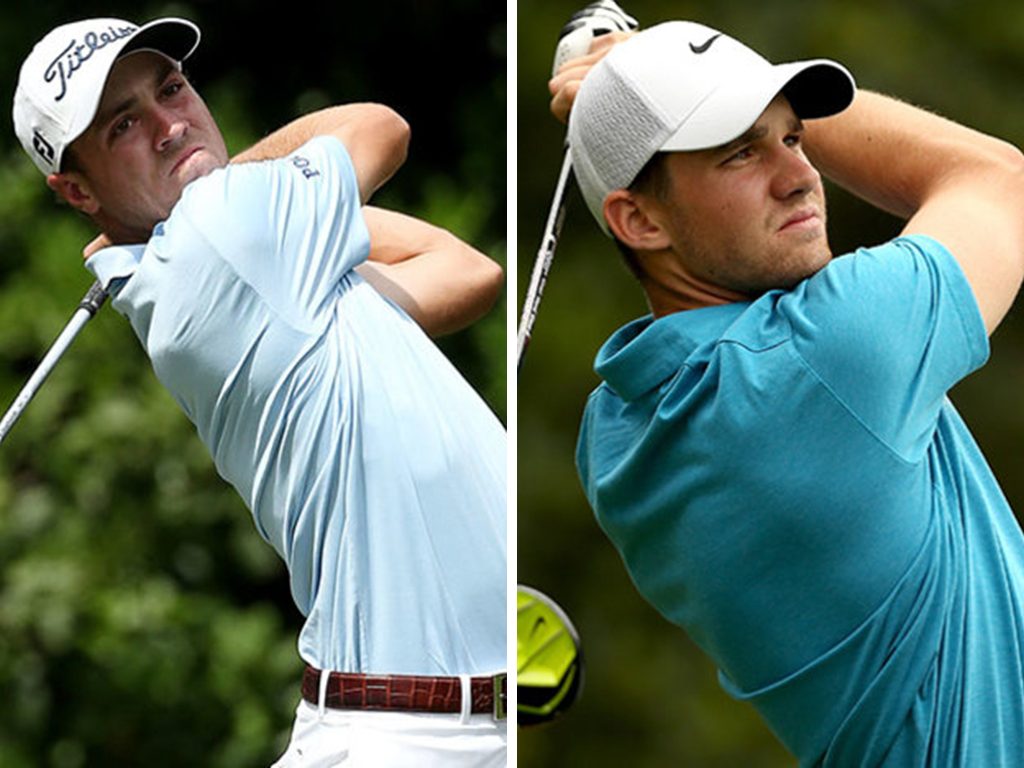
Two prime examples of this are rookies Justin Thomas and Patrick Rodgers, both of whom are 22 years old. It should be noted that Rodgers and Thomas are ranked Nos. 1 and 2 in Max Height, respectively.
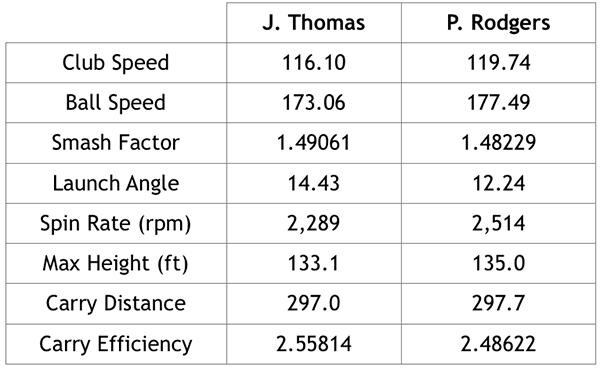
Currently, Thomas ranks 73rd (out of 203 golfers) in my Driving Effectiveness ranking, while Rodgers ranks 59th. There is not a lot of data with regards to higher-speed players who produce very high launch numbers over a significant period of time, but the long hitters who are generally more effective off the tee average lower launch numbers like Bubba Watson, who currently first in Driving Effectiveness.
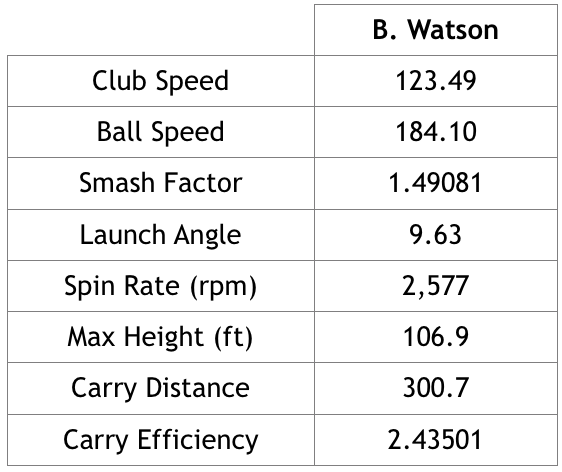
I suspect that eventually players like Thomas and Rodgers will bring down their attack angles a bit in order to create a lower launch, a lower max height and a higher spin rate so they can drive ball more accurately and precisely like Bubba does. But young guns like Thomas and Rodgers, as well as the Tour radar statistics as a whole, show the great influence that launch monitors are having on the best golfers in the world.


Club Junkie
Building my 2026 gamer WITB: Ranking the contenders and new putter projects – Club Junkie Podcast

The annual What’s In The Bag build is underway, and on this episode of Club Junkie, Brian breaks down the clubs currently leading the race for a spot in his 2026 gamer setup. From drivers and fairway woods to irons, wedges, and shafts, he ranks the equipment that’s performing best and explains what’s separating the front runners from the rest of the field.
Brian also heads into the workshop to discuss several putter projects currently on the bench. From head options and shaft choices to build ideas and testing plans, he shares what he’s working on and which putters could become serious contenders for the bag this season.
If you’re a gear junkie who loves equipment testing, club building, and the never-ending pursuit of the perfect setup, this episode is for you.
Follow Club Junkie:
Instagram: @clubjunkiepod
TikTok: @clubjunkiepod
Threads: @clubjunkiepod
X: @ClubJunkiePod
Club Junkie
Tour Edge Exotics mini driver review + TaylorMade Spider ZT Max first look – Club Junkie

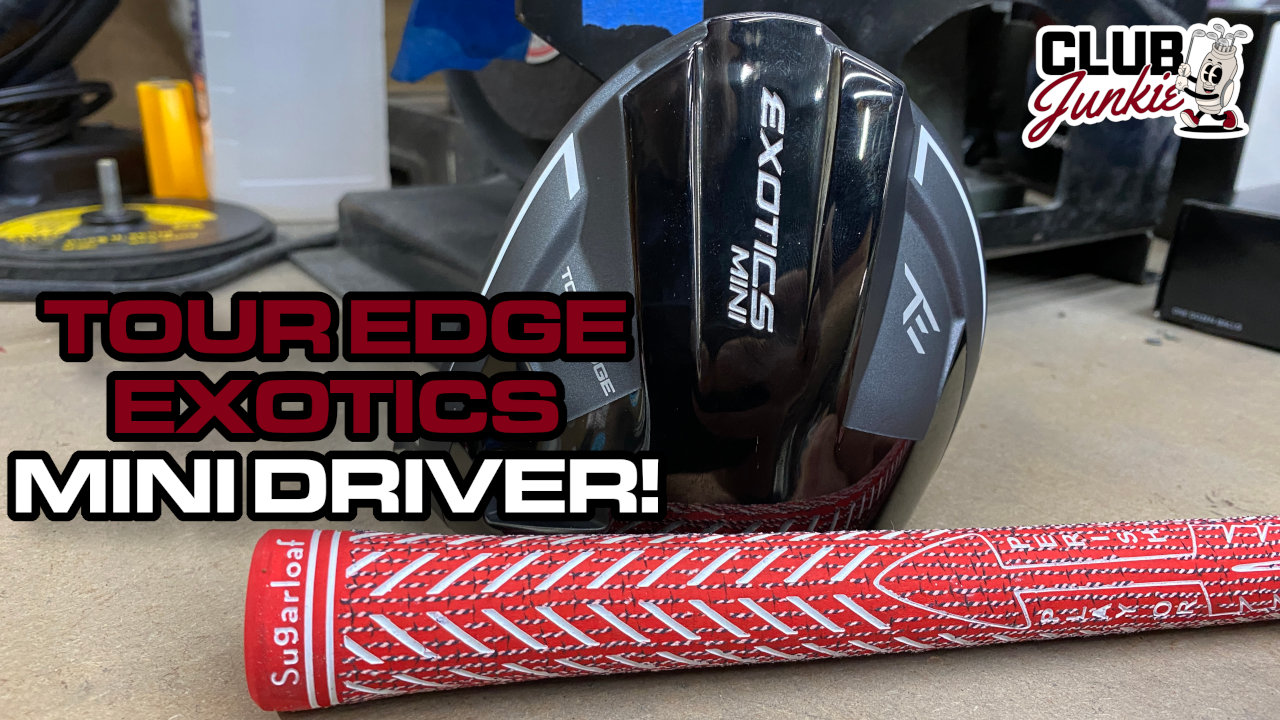
On this episode of Club Junkie, I put the new Tour Edge Exotics Mini Driver to the test and break down the performance, forgiveness, distance, and where it fits compared to a traditional driver or strong fairway wood. If you have been curious about adding a mini driver to the bag, this one is worth a look.
I also dive into the new TaylorMade Spider ZT Max putter that was recently spotted and discuss the growing zero torque putter trend. Plus, there is a closer look at the new Project X Titan Yellow shaft showing up on the PGA Tour and what makes it different from other profiles currently out there.
Opinion & Analysis
AVL: We’re talking about practice! My best tips for taking your game to the course

With the beginning of June on the horizon and courses rounding into peak condition for the season, it’s time to hone the finer skills that often get rusty over the winter. More sunlight also means more time to get out on the course and work on your game.
Whether it’s the practice green or the driving range, there’s always something to improve—whether you’re enjoying the fresh air or preparing for a weekend game or tournament. You can work on drills or freestyle around the green, and friendly competition is a great way to sharpen your skills.
While there are endless ways to get better at golf, I’m going to focus on practicing around the green. Let’s take a look at a few things to keep in mind as we head into the summer months.
Drills
From the driving range to the practice green, it’s important to incorporate drills into your routine. Years ago, I spent a weekend working on my short game with James Sieckmann. He recommended doing drill work for 5–10 minutes, then returning to your main practice.
This way, you create a balance between structured drills and real-world scenarios, so you’re not confined to “perfect” situations. For example, hitting the same three-foot putt over and over is good for repetition, but after a while, it becomes less interactive for your brain.
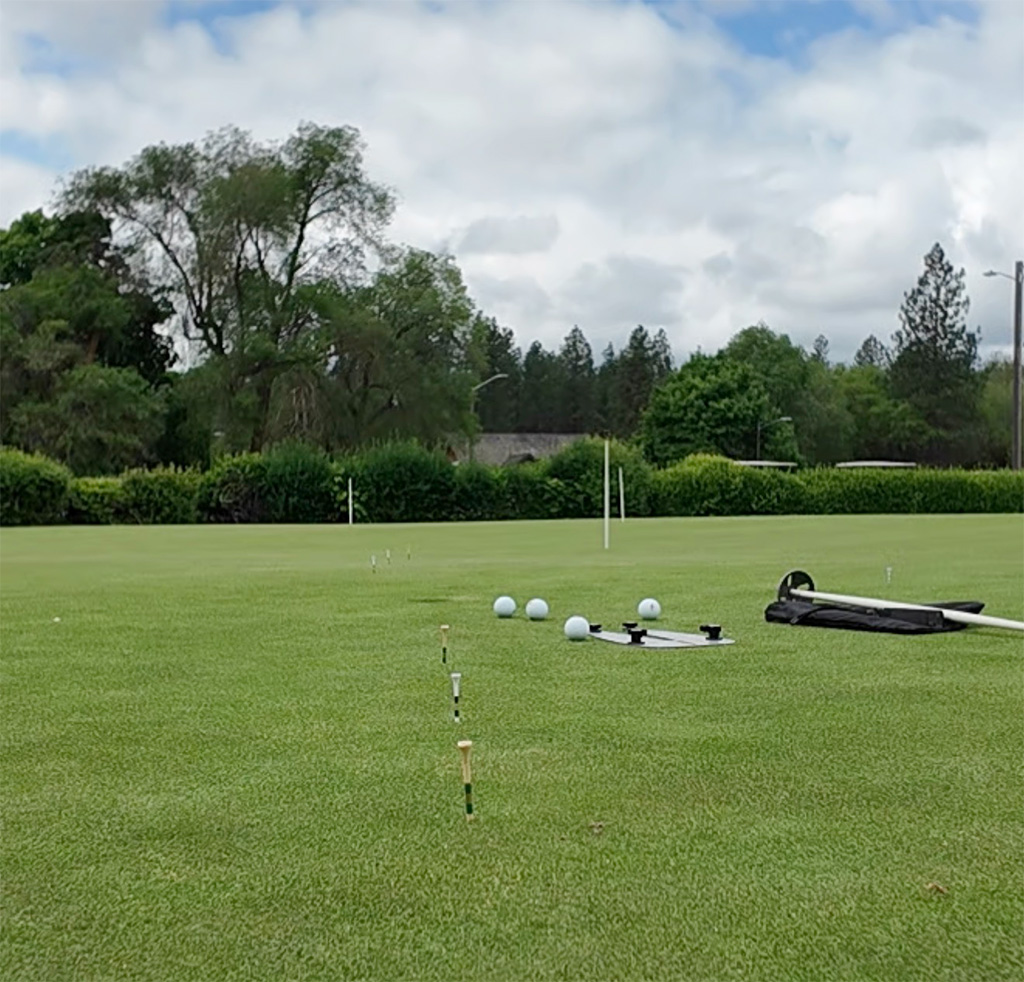
My approach is to use a putting trainer with a narrow gate for the ball to pass through, or simply place tees just outside the width of the ball. I’ll hit a series of four putts through the gate for three sets. Then, from a similar distance, I’ll hit four putts without the training aid and repeat that sequence three times.
Next, I’ll hit a number of 15–25 foot putts in a random fashion, then circle back to repeat the short putt drills with and without the training aid.
This breaks up the rhythm of hitting short putts with the training aid. When you hit the same short putts over and over, it’s easy to get into a groove—which is great for the drill, but not reflective of actual course play. While finding a rhythm is fundamental for drills, I like to introduce variation with longer putts to keep things realistic.
Game Mode
Once you’ve established a foundation with drills, it’s time to simulate on-course scenarios. This is where a few practice games come in handy.
One that I’ve been enjoying lately involves putting 10- to 15-footers with two balls. If I make the putt, great! If I miss, I pull the missed ball back a putter length. Suddenly, that little tap-in becomes a nerve-wracking three-footer—at least at first. As you get better at this game, those three- and five-footers become much more comfortable and routine.
It may sound cliché, but each shot is just what it is—it’s how we react that makes the difference. I like this game because it blends the pressure of on-course putting with the consequence of leaving yourself a much longer putt than usual.
Another game I like is one I recently learned from Brad Faxon. Place three tees in a line at four different locations around the hole: one at 3 feet, one at 6 feet, and one at 8 feet. The 3- and 6-foot putts count as par, and the 8-footer is for birdie.
This game keeps you focused on scoring and helps you get into a competitive mindset. You can even think about this putting game while you’re on the course. I just started playing it, and last week I couldn’t get better than two under par.
Competition
Competition during practice is when drills and games come to life, and you start to see results. For me, nothing beats a putting contest with a friend or two. In the right setting, these contests can become talking points for the whole season.
Match play, a game of 21, or simply seeing who can make the most one-putts (with a small prize on the line) are all great ways to simulate real on-course pressure. Recently, I played in a putting contest where one competitor made back-to-back 30- and 50-foot putts. As they say, expect your opponent to make every putt—and he nearly did. That’s impressive, and it’s something you see on the course, too: you have to stay committed to your game plan, no matter what.
When it comes to practice, it’s important to blend feedback from recent rounds with the fundamentals you want to reinforce. Drills, games, and competition—from the driving range to the putting green—form the backbone of skills you’ll rely on during actual rounds.
Finding the right balance is something we’re all working on, one practice session at a time. With the beginning of June on the horizon and courses rounding into peak condition for the season, it’s time to hone the finer skills that often get rusty over the winter. More sunlight also means more time to get out on the course and work on your game. Whether it’s the practice green or the driving range, there’s always something to improve—whether you’re enjoying the fresh air or preparing for a weekend game or tournament. You can work on drills or freestyle around the green, and friendly competition is a great way to sharpen your skills. While there are endless ways to get better at golf, I’m going to focus on practicing around the green. Let’s take a look at a few things to keep in mind as we head into the summer months.
Drills
From the driving range to the practice green, it’s important to incorporate drills into your routine. Years ago, I spent a weekend working on my short game with James Sieckmann. He recommended doing drill work for 5–10 minutes, then returning to your main practice. This way, you create a balance between structured drills and real-world scenarios, so you’re not confined to “perfect” situations. For example, hitting the same three-foot putt over and over is good for repetition, but after a while, it becomes less interactive for your brain.
My approach is to use a putting trainer with a narrow gate for the ball to pass through, or simply place tees just outside the width of the ball. I’ll hit a series of four putts through the gate for three sets. Then, from a similar distance, I’ll hit four putts without the training aid and repeat that sequence three times. Next, I’ll hit a number of 15–25 foot putts in a random fashion, then circle back to repeat the short putt drills with and without the training aid.
This breaks up the rhythm of hitting short putts with the training aid. When you hit the same short putts over and over, it’s easy to get into a groove—which is great for the drill, but not reflective of actual course play. While finding a rhythm is fundamental for drills, I like to introduce variation with longer putts to keep things realistic.
Game Mode
Once you’ve established a foundation with drills, it’s time to simulate on-course scenarios. This is where a few practice games come in handy. One that I’ve been enjoying lately involves putting 10- to 15-footers with two balls. If I make the putt, great! If I miss, I pull the missed ball back a putter length.
Suddenly, that little tap-in becomes a nerve-wracking three-footer—at least at first. As you get better at this game, those three- and five-footers become much more comfortable and routine. It may sound cliché, but each shot is just what it is—it’s how we react that makes the difference. I like this game because it blends the pressure of on-course putting with the consequence of leaving yourself a much longer putt than usual.
Another game I like is one I recently learned from Brad Faxon. Place three tees in a line at four different locations around the hole: one at 3 feet, one at 6 feet, and one at 8 feet. The 3- and 6-foot putts count as par, and the 8-footer is for birdie.
This game keeps you focused on scoring and helps you get into a competitive mindset. You can even think about this putting game while you’re on the course. I just started playing it, and last week I couldn’t get better than two under par.
Competition
Competition during practice is when drills and games come to life, and you start to see results. For me, nothing beats a putting contest with a friend or two. In the right setting, these contests can become talking points for the whole season. Match play, a game of 21, or simply seeing who can make the most one-putts (with a small prize on the line) are all great ways to simulate real on-course pressure. Recently, I played in a putting contest where one competitor made back-to-back 30- and 50-foot putts. As they say, expect your opponent to make every putt—and he nearly did. That’s impressive, and it’s something you see on the course, too: you have to stay committed to your game plan, no matter what.
When it comes to practice, it’s important to blend feedback from recent rounds with the fundamentals you want to reinforce. Drills, games, and competition—from the driving range to the putting green—form the backbone of skills you’ll rely on during actual rounds. Finding the right balance is something we’re all working on, one practice session at a time.

Justin Rose WITB 2026 (April): Full WITB breakdown with new McLaren irons

What’s the story behind Webb Simpson’s custom-stamped irons?

Cadillac Championship Tour Report: Spieth’s sizable changes, McLaren Golf launches, and more

Russell Henley’s winning WITB: 2026 Charles Schwab Challenge

Kristoffer Reitan’s winning WITB: 2026 Truist Championship

Aaron Rai’s winning WITB: 2026 PGA Championship

Cameron Young’s winning WITB: 2026 Cadillac Championship

Details on Jason Day’s latest prototype Avoda iron setup

Nelly Korda WITB 2026 (April)

Justin Rose on the switch to McLaren Golf, learnings from previous equipment moves


Melanie Green WITB 2026 (June)
Driver: TaylorMade Qi4D (9 degrees) Shaft: Graphite Design Tour AD VF 5 S 3-wood: TaylorMade Qi4D (15 degrees) Shaft: Graphite Design Tour...


Sungjae Im WITB 2026 (June)
Sungjae Im had >14 clubs in his bag when photographed prior to the Memorial Tournament. Driver: Titleist TSi2 (8 degrees, B1...


Lucas Glover WITB 2026 (June)
Lucas Glover had >14 clubs in his bag when photographed prior to the Memorial Tournament. Driver: Titleist GTS2 (10 degrees, B2 SureFit...

Chris Gotterup WITB 2026 (June)
Chris Gotterup had >14 clubs in his bag when photographed prior to the Memorial Tournament. Drivers: TaylorMade Qi4D (8 degrees), Ping...
-
 News5 days ago
Russell Henley’s winning WITB: 2026 Charles Schwab Challenge
-
 Whats in the Bag3 weeks ago
Aaron Rai’s winning WITB: 2026 PGA Championship
-
 Equipment2 days ago
Details on Jason Day’s latest prototype Avoda iron setup
-
 Tour Photo Galleries3 weeks ago
Photos from the 2026 CJ Cup Byron Nelson
-

 Equipment2 weeks ago
CJ Cup Byron Nelson Tour Report: Koepka and Kim’s newest putters finally get hot
-
 News1 week ago
Charles Schwab Challenge Tour Report: MacIntyre, Åberg and Spaun all switch putters, TaylorMade launches new Spider
-
 Equipment1 week ago
Details on J.J. Spaun’s surprise putter switch
-
 Popular Photo Galleries2 weeks ago
Photos from the 2026 Charles Schwab Challenge


spanishflypro.net
Jun 9, 2015 at 2:12 pm
I read this article fully regarding the comparison of latest and previous technologies, it’s amazing article.
Stat Man
Jun 6, 2015 at 7:48 pm
AoA -1
Oldplayer
Jun 6, 2015 at 5:48 pm
Is the ball at all responsible for the higher launch and lower spin that pros are getting in recent times?
Jeez Utz
Jun 6, 2015 at 5:39 pm
Stats are so padded and no one should really be interested in them
Jeez Utz
Jun 6, 2015 at 5:34 pm
I don’t know why ppl put stock in stats
Stats tell part of the story….
3rd and 23, defense in full prevent..handoff up the middle rb gets 16 yds. That happens 3 or 4 times a game and he finishes with 103 yds total
Outside that the rb will have 23 carries for 48 yds but if you look at the stats he’s shredding the defense
Baseball would have you believe a save is a something that should be recorded as a stat
One team is up 8-5 in the bottom of the 9th and a guy comes out and throw 8 pitches against another team that knows they’ve already lost and don’t care
Basketball has the assist…I throw the ball to a wide open or covered guy and he shoots and makes it. Nothing to do with me but I get a + in a stat category…
idk but I’m pretty sure the winner on tour week in and week out is 1 or 2 in prox. to the hole. He may be middle of the pack or closer to last in a few or most categories, but never that one. That’s the only “stat” that matters, but at the end of the day score matters and not much else and especially not scoring average because of course setup.
Andrew
Jun 9, 2015 at 11:31 am
You never told us the price of tea in China.
Jeez Utz
Jun 9, 2015 at 11:44 am
nice comment troll
Tom Stickney
Jun 6, 2015 at 12:57 am
Its amazing how high and flat the tour guys hit the ball when the spin rate is under control.
Paul
Jun 6, 2015 at 12:10 am
Good stuff Richie.
Great information – gives us food for thought. Whether it’s a deliberate change that the players have implemented or if the club design is the reason behind it, it is still an interesting subject.
golfiend
Jun 5, 2015 at 11:43 pm
i guess these stats could be interesting, but the more important stat is how often these guys drive it accurately (even if they are 5-10y shorter) to the right location in the fairway to get an easier second shot into the green
Steve
Jun 5, 2015 at 11:12 pm
Wow this is news. Tech has change the way we look at a golf swing? is this 2005?
ML
Jun 5, 2015 at 6:13 pm
If they limited the size of the driver head it would have no effect
Many guys are playing smaller heads than retail to begin with
They new mini drivers (essentially a 90’s driver ) are extremely accurate for most players and when flushed go nearly as far as the drivers do
I’ve got to a point where I wonder why I even have a driver other than to make double on a couple par 5’s
275 in the middle with those mini drivers is all you need
Johnny
Jun 5, 2015 at 4:01 pm
Interesting that launch angles are virtually unchanged from 2007 to 2015 while max height shows a pretty good change. So when we talk about high launch/low spin, I’m not sure about the high launch part. Yet spin has a pretty good drop as well.
If tour players are hitting their drives different, I would have to say it’s due to the driver and not the launch monitor.
Jeez Utz
Jun 6, 2015 at 5:12 pm
my point exactly
I would be slightly more to believe in launch monitors bringing down scoring average cuz players find “square” more easily
Rich Hunt
Jun 8, 2015 at 2:45 pm
The launch angles have gone up and much like smash factor and carry efficiency, there’s a ceiling as to how much you can go up with the launch of a driver and swing at a certain speed. So I think that like smash and carry efficiency, the launch angle going up by a small number is actually a bigger change than most people think.
As I mentioned towards the end, the big difference I see is the numbers for the longer hitters. Guys like Rodgers and Thomas just used to never have those numbers. Used to be lower launch, higher spin. Now we are starting to see more long hitters change that.
ca1879
Jun 5, 2015 at 2:24 pm
Rich – hard to show significant change with just averages since all influences are aggregated. Since you clearly know this subject, can we assume that there isn’t enough information to tease out the performance deltas with respect to actual swing metric changes?
Chris
Jun 5, 2015 at 1:11 pm
Rich, while there are definitely some trends in regards to players increasing their launch and lowering their spin, I think this may have more to do with the improvement of equipment design over the last 8 years more-so than players changing their swings. Back in 2007 clubs were being marketed as having the deepest CG’s providing the most forgiveness. Nowadays the clubs are the complete opposite with low and forward CG’s.
Jeez Utz
Jun 5, 2015 at 1:04 pm
Launch monitors have changed how tour players hit their drivers????
Where’s the proof
ShutSteepStuck
Jun 5, 2015 at 12:30 pm
Great article, Rich. Would love to know the AoA. Pretty sure Tomas is in the +4 range, but not sure about Rogers.
Dennis Clark
Jun 5, 2015 at 12:01 pm
Rich any attack angle data?
Rich Hunt
Jun 5, 2015 at 3:37 pm
Unfortunately, there is no AoA data on Tour.
Dennis Clark
Jun 5, 2015 at 8:06 pm
Yea it seems that all Tman gives is ball flight never individual impact/club readings. Wondering if they might be proprietary.
Rich Hunt
Jun 8, 2015 at 2:47 pm
I was told that there are too many mis-reads when they track them during an event, so they throw them out.
It’s pretty easy to tell what guys are hitting up versus hitting down though with all of the other numbers.
Greg V
Jun 5, 2015 at 10:47 am
Good article. Not taking anything away from the phenomenal ability of Tour players to generate club head speed in combination with precise ball striking – which is a gift.
But we see that an average increase in club head speed of 0.8 mph over the past 8 years has yielded an additional carry distance of over 9 yards. Part of reason is that players are generating better launch angles – an improvement in technique. But a big part is also that manufacturers are making drivers with higher launch/lower spin characteristics.
Long drivers will always be long drivers, no matter what equipment they are using. But, it is difficult to stretch golf courses. With the trampoline effect inherent in modern titanium driver heads, longer drivers get a proportionately higher rebound effect than more moderate drivers. This doesn’t bother me as I compare my performance versus a Tour pro; but it does bother me as I compare their performance against the course relative to players from as little as 25 years ago.
The USGA/R&A has been in denial relative to the advance in driver club head technology. It is time to roll back the ball, and roll back the COR of driver faces. In fact, it would be a better test of skill if driver head sizes were rolled back to around 1/2 the size of today’s driver heads – 230 cc. Let’s put more skill into playing off the tee for our highly skilled players. Even though I can’t come close to their skill, I would also adopt the new driver head size – even for my puny ss of 92.
MHendon
Jun 5, 2015 at 12:02 pm
Greg I’ve seen this argument made over and over again about rolling back the ball and the driver because players are just getting to long. I’ll point out that average driving distance has actually been coming down the last few years and it’s only 285 right now on tour. Also the longest driving avg for a season goes all the way back to 2004, thanks Hank Kuene for that one. So while it may be true that there is more focus on distance than ever the distance numbers for an entire season have not chance significantly since the early 2000’s.
Ball
Jun 5, 2015 at 1:02 pm
I’d also like to add that in general, the courses on the PGA Tour are not as difficult as it looks because the fairways are wide and there isn’t much rough, coupled with clean sight lines without many trees or obstacles that they would have to curve the ball – because of TV viewing angle requirements, and because nobody wants to see poor scoring at courses that have thick rough. The modern ball travels fast and straight, with not much curving, and cuts through the wind really well too. It’s a mythical perception that Bubba curves the ball a lot – he does curve it fairly well, but you see him struggle on courses with tight fairways being guarded by tall trees on both sides of the fairway. That’s why you never see him do well or even show up at places like Harbour Town – way too tight for him to be curving his bombers – he doesn’t like to plod through the course like a Jim Furyk.
If the courses forced the long and wild hitters to be more accurate, these guys wouldn’t always be swinging away with their big sticks all over the map, you would see thoughtful, conservative swinging to put the ball in play – but then the public don’t want to see 9 or 10 drives with hybrids and fairway woods, do they?
Jeff Borders
Jun 9, 2015 at 2:32 am
You’ve never been to the Memorial in Dublin, Ohio. There’s nothing easy about Muirfield Village. The short 14 is an easy layup, but a difficult wedge into a “fade” narrow green. The drive on 15, which many birdie, is a narrow shoot with a hog back fairway. You miss any of those greens and you get punished. on 18, I noticed many of those guys teeing off with fairway woods and long irons and leaving themselves 185-200 yards to an uphill green. Those shots are not in my bag. I also watched those guys hit pure shot after pure shot at the range with every club in the bag.
KK
Jun 6, 2015 at 1:27 am
Should we really focus on how golfers scored 25 years ago? Just about every sport has evolved to address inherent issues and to better provide participants and viewers with more enjoyment and entertainment. We’re losing tens of thousands of golfers every year in the US. Making golf more difficult is not the answer. If you can’t see that, you really don’t care about golf, only your ego.
gvogel
Jun 6, 2015 at 10:00 am
1. I am not calling for a roll back for the average golfer.
2. Even with a roll back, the Tour professional will still amaze the viewer with length and accuracy that are hard to comprehend.
Long is long; a Tour pro can hit a hickory driver longer than I can comprehend. A smaller club head would make driving a bit harder, which would be good for the game.
One of the reasons that many players are leaving the game is that the game is hard. Modern courses are long, and difficult. IF the equipment is rolled back for elite players, courses can play shorter. Shorter courses take less time to play. The average player needs shorter courses, and shorter rounds.
The game is hard, and it should remain that way. It requires patience, dedication, practice, and experience. But instead of making new courses longer and harder, we can make the equipment harder to use – for the elite player, and those who want to truly test themselves against that metric. That means playing exactly by the rules. But there should also be a class of golfer who plays for fun; drop a ball where it went out of bounds, etc. Those players could have the benefit of modern driver heads – and shorter golf courses.
epyon
Jun 5, 2015 at 10:10 am
Shouldn’t smash factor = Ball Speed / Club head speed? I think its reversed in the article.
Zak Kozuchowski
Jun 5, 2015 at 10:14 am
Yes, and we have made that correction. Thanks for pointing out our mistake.
patrick
Jun 5, 2015 at 9:09 am
Rich I’m a big fan.of your articles. And because you’re a statics guy it adds to your credibility. I wish I was 22 again and had access to a launch monitor.
I saw the PGA tour video on Justin Thomas and his ability to consistently hit exactly the same spot on his driver plus his ability to replicate his swing faithfully , led to.his phenomenal smash factor. Like Bubba Watson , Justin Thomas has a gift. All you can do is sit back and admire.