
Opinion & Analysis
Move over, Augusta National: Pine Valley tops Golf Digest’s Top 100


Golf Digest’s Ron Whitten writes that, since its inception, the biennial ranking of America’s 100 Greatest Golf Courses has illustrated the fact that polarized opinions are “a reminder that variety is the essence of the game.”
The poles of opinion regarding course design may best be illustrated by widely different attributes of the No. 1 and No. 2 courses in the ranking.
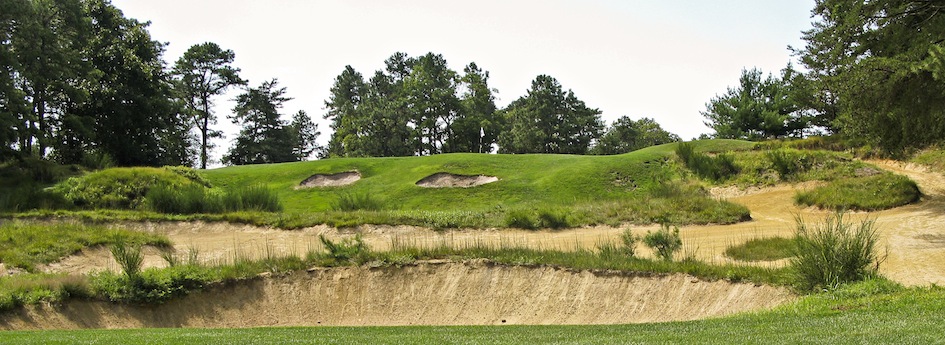
The aesthetic at Pine Valley.
George Crump-founded Pine Valley Golf Club in New Jersey reassumes the top spot in GD’s rundown this year, with Augusta National falling to No. 2. Whitten notes that Pine Valley was a mainstay in the top spot for decades, but has been tops only once in the past five surveys. ANGC was No. 1 in 2009, 2011, and 2015.
“The tussle between these two titans will undoubtedly continue, not because of indecision on the part of our panelists, but because golf architecture in America will never become homogenized,” Whitten writes presciently.
Newcomers to the biennial ranking include, Spring Hill, No. 91 Essex County Club in Massachusetts, No. 98 Sahalee Country Club near Seattle, and No. 99 Mayacama in Northern California. Whitten notes this is the fewest number of new inclusions since 1985.
Another interesting note, for what it’s worth, Digest names Tiger Woods’ Bluejack National in Montgomery, Texas, as the top new private course of 2016.
The bottom line: Few would argue that Pine Valley and Augusta National are the best of their relative breeds, that is “penal” and “heroic” courses, to use Golf Digest’s terminology, respectively. But when it comes to deciding which of the two deserves the top spot (and don’t forget Cypress Point!), there’s plenty of room for debate.
What say you, WRXers?
*Featured photo: 11th hole at Pine Valley. Credit to Golf Digest.


Club Junkie
Building my 2026 gamer WITB: Ranking the contenders and new putter projects – Club Junkie Podcast

The annual What’s In The Bag build is underway, and on this episode of Club Junkie, Brian breaks down the clubs currently leading the race for a spot in his 2026 gamer setup. From drivers and fairway woods to irons, wedges, and shafts, he ranks the equipment that’s performing best and explains what’s separating the front runners from the rest of the field.
Brian also heads into the workshop to discuss several putter projects currently on the bench. From head options and shaft choices to build ideas and testing plans, he shares what he’s working on and which putters could become serious contenders for the bag this season.
If you’re a gear junkie who loves equipment testing, club building, and the never-ending pursuit of the perfect setup, this episode is for you.
Follow Club Junkie:
Instagram: @clubjunkiepod
TikTok: @clubjunkiepod
Threads: @clubjunkiepod
X: @ClubJunkiePod
Club Junkie
Tour Edge Exotics mini driver review + TaylorMade Spider ZT Max first look – Club Junkie

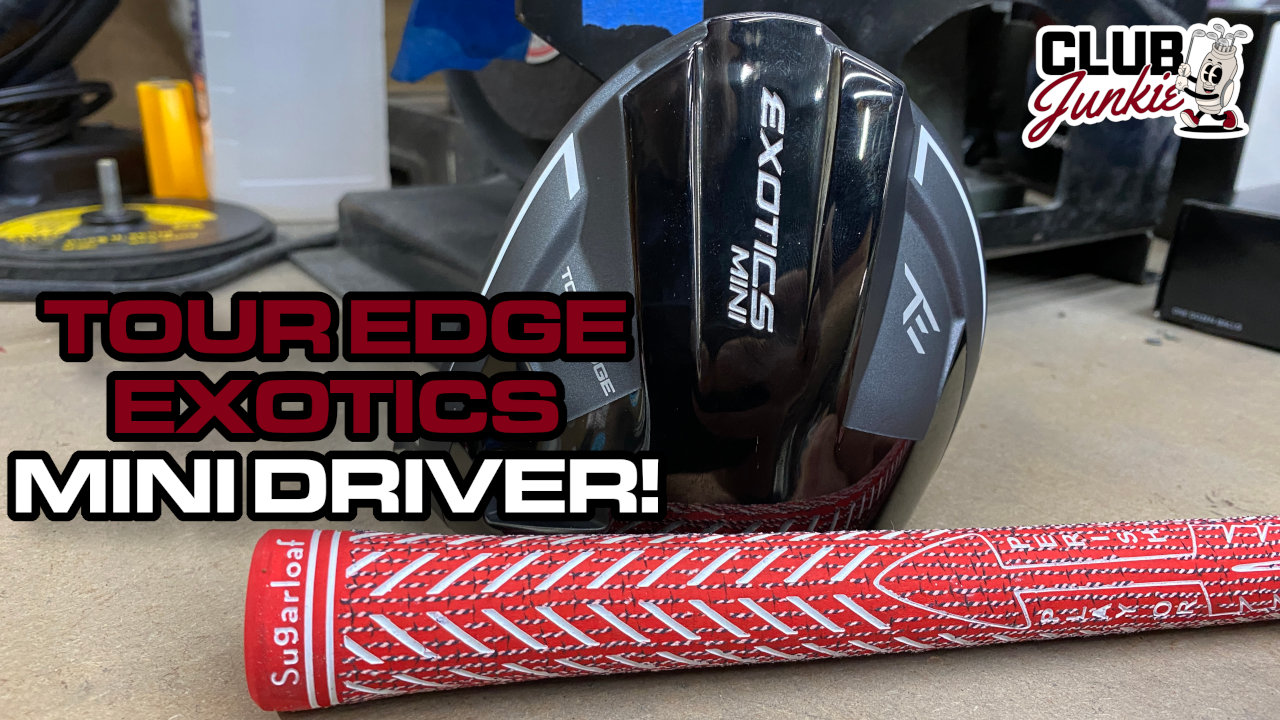
On this episode of Club Junkie, I put the new Tour Edge Exotics Mini Driver to the test and break down the performance, forgiveness, distance, and where it fits compared to a traditional driver or strong fairway wood. If you have been curious about adding a mini driver to the bag, this one is worth a look.
I also dive into the new TaylorMade Spider ZT Max putter that was recently spotted and discuss the growing zero torque putter trend. Plus, there is a closer look at the new Project X Titan Yellow shaft showing up on the PGA Tour and what makes it different from other profiles currently out there.
Opinion & Analysis
AVL: We’re talking about practice! My best tips for taking your game to the course

With the beginning of June on the horizon and courses rounding into peak condition for the season, it’s time to hone the finer skills that often get rusty over the winter. More sunlight also means more time to get out on the course and work on your game.
Whether it’s the practice green or the driving range, there’s always something to improve—whether you’re enjoying the fresh air or preparing for a weekend game or tournament. You can work on drills or freestyle around the green, and friendly competition is a great way to sharpen your skills.
While there are endless ways to get better at golf, I’m going to focus on practicing around the green. Let’s take a look at a few things to keep in mind as we head into the summer months.
Drills
From the driving range to the practice green, it’s important to incorporate drills into your routine. Years ago, I spent a weekend working on my short game with James Sieckmann. He recommended doing drill work for 5–10 minutes, then returning to your main practice.
This way, you create a balance between structured drills and real-world scenarios, so you’re not confined to “perfect” situations. For example, hitting the same three-foot putt over and over is good for repetition, but after a while, it becomes less interactive for your brain.
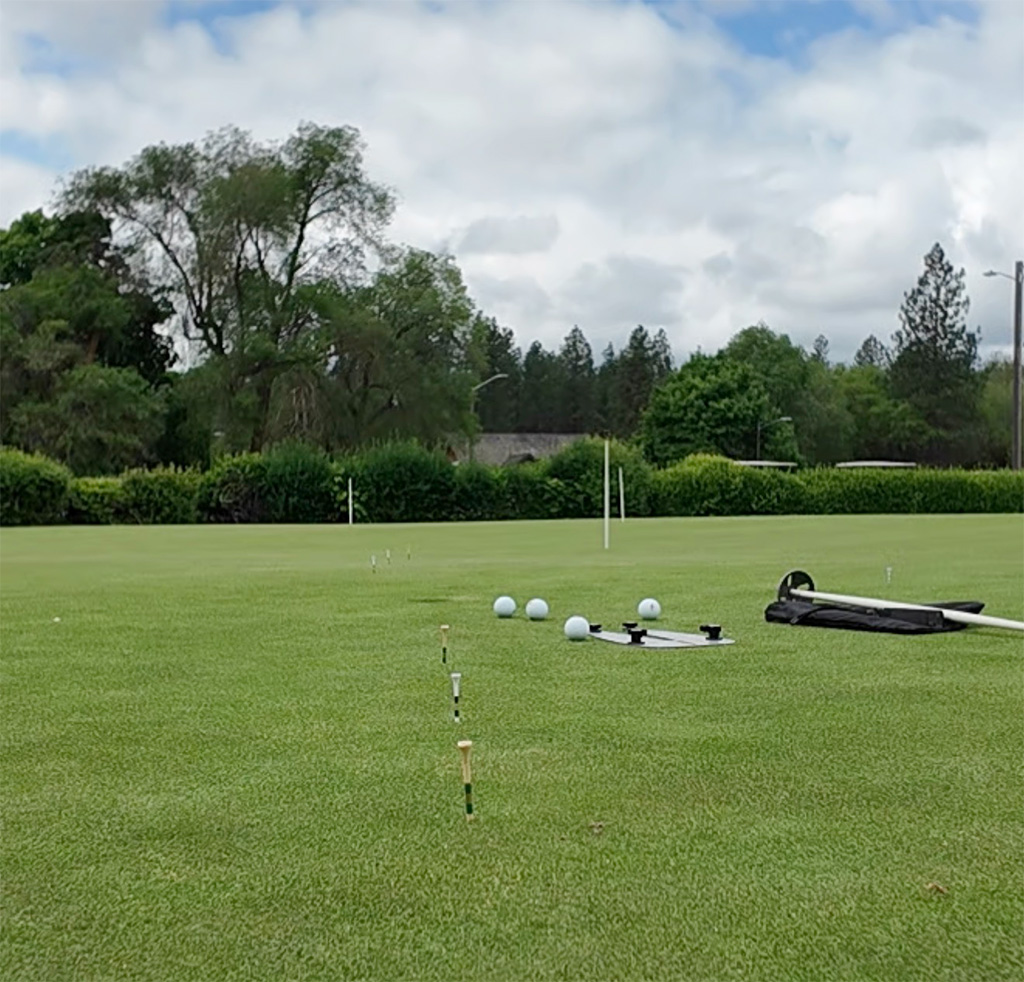
My approach is to use a putting trainer with a narrow gate for the ball to pass through, or simply place tees just outside the width of the ball. I’ll hit a series of four putts through the gate for three sets. Then, from a similar distance, I’ll hit four putts without the training aid and repeat that sequence three times.
Next, I’ll hit a number of 15–25 foot putts in a random fashion, then circle back to repeat the short putt drills with and without the training aid.
This breaks up the rhythm of hitting short putts with the training aid. When you hit the same short putts over and over, it’s easy to get into a groove—which is great for the drill, but not reflective of actual course play. While finding a rhythm is fundamental for drills, I like to introduce variation with longer putts to keep things realistic.
Game Mode
Once you’ve established a foundation with drills, it’s time to simulate on-course scenarios. This is where a few practice games come in handy.
One that I’ve been enjoying lately involves putting 10- to 15-footers with two balls. If I make the putt, great! If I miss, I pull the missed ball back a putter length. Suddenly, that little tap-in becomes a nerve-wracking three-footer—at least at first. As you get better at this game, those three- and five-footers become much more comfortable and routine.
It may sound cliché, but each shot is just what it is—it’s how we react that makes the difference. I like this game because it blends the pressure of on-course putting with the consequence of leaving yourself a much longer putt than usual.
Another game I like is one I recently learned from Brad Faxon. Place three tees in a line at four different locations around the hole: one at 3 feet, one at 6 feet, and one at 8 feet. The 3- and 6-foot putts count as par, and the 8-footer is for birdie.
This game keeps you focused on scoring and helps you get into a competitive mindset. You can even think about this putting game while you’re on the course. I just started playing it, and last week I couldn’t get better than two under par.
Competition
Competition during practice is when drills and games come to life, and you start to see results. For me, nothing beats a putting contest with a friend or two. In the right setting, these contests can become talking points for the whole season.
Match play, a game of 21, or simply seeing who can make the most one-putts (with a small prize on the line) are all great ways to simulate real on-course pressure. Recently, I played in a putting contest where one competitor made back-to-back 30- and 50-foot putts. As they say, expect your opponent to make every putt—and he nearly did. That’s impressive, and it’s something you see on the course, too: you have to stay committed to your game plan, no matter what.
When it comes to practice, it’s important to blend feedback from recent rounds with the fundamentals you want to reinforce. Drills, games, and competition—from the driving range to the putting green—form the backbone of skills you’ll rely on during actual rounds.
Finding the right balance is something we’re all working on, one practice session at a time. With the beginning of June on the horizon and courses rounding into peak condition for the season, it’s time to hone the finer skills that often get rusty over the winter. More sunlight also means more time to get out on the course and work on your game. Whether it’s the practice green or the driving range, there’s always something to improve—whether you’re enjoying the fresh air or preparing for a weekend game or tournament. You can work on drills or freestyle around the green, and friendly competition is a great way to sharpen your skills. While there are endless ways to get better at golf, I’m going to focus on practicing around the green. Let’s take a look at a few things to keep in mind as we head into the summer months.
Drills
From the driving range to the practice green, it’s important to incorporate drills into your routine. Years ago, I spent a weekend working on my short game with James Sieckmann. He recommended doing drill work for 5–10 minutes, then returning to your main practice. This way, you create a balance between structured drills and real-world scenarios, so you’re not confined to “perfect” situations. For example, hitting the same three-foot putt over and over is good for repetition, but after a while, it becomes less interactive for your brain.
My approach is to use a putting trainer with a narrow gate for the ball to pass through, or simply place tees just outside the width of the ball. I’ll hit a series of four putts through the gate for three sets. Then, from a similar distance, I’ll hit four putts without the training aid and repeat that sequence three times. Next, I’ll hit a number of 15–25 foot putts in a random fashion, then circle back to repeat the short putt drills with and without the training aid.
This breaks up the rhythm of hitting short putts with the training aid. When you hit the same short putts over and over, it’s easy to get into a groove—which is great for the drill, but not reflective of actual course play. While finding a rhythm is fundamental for drills, I like to introduce variation with longer putts to keep things realistic.
Game Mode
Once you’ve established a foundation with drills, it’s time to simulate on-course scenarios. This is where a few practice games come in handy. One that I’ve been enjoying lately involves putting 10- to 15-footers with two balls. If I make the putt, great! If I miss, I pull the missed ball back a putter length.
Suddenly, that little tap-in becomes a nerve-wracking three-footer—at least at first. As you get better at this game, those three- and five-footers become much more comfortable and routine. It may sound cliché, but each shot is just what it is—it’s how we react that makes the difference. I like this game because it blends the pressure of on-course putting with the consequence of leaving yourself a much longer putt than usual.
Another game I like is one I recently learned from Brad Faxon. Place three tees in a line at four different locations around the hole: one at 3 feet, one at 6 feet, and one at 8 feet. The 3- and 6-foot putts count as par, and the 8-footer is for birdie.
This game keeps you focused on scoring and helps you get into a competitive mindset. You can even think about this putting game while you’re on the course. I just started playing it, and last week I couldn’t get better than two under par.
Competition
Competition during practice is when drills and games come to life, and you start to see results. For me, nothing beats a putting contest with a friend or two. In the right setting, these contests can become talking points for the whole season. Match play, a game of 21, or simply seeing who can make the most one-putts (with a small prize on the line) are all great ways to simulate real on-course pressure. Recently, I played in a putting contest where one competitor made back-to-back 30- and 50-foot putts. As they say, expect your opponent to make every putt—and he nearly did. That’s impressive, and it’s something you see on the course, too: you have to stay committed to your game plan, no matter what.
When it comes to practice, it’s important to blend feedback from recent rounds with the fundamentals you want to reinforce. Drills, games, and competition—from the driving range to the putting green—form the backbone of skills you’ll rely on during actual rounds. Finding the right balance is something we’re all working on, one practice session at a time.

Justin Rose WITB 2026 (April): Full WITB breakdown with new McLaren irons

What’s the story behind Webb Simpson’s custom-stamped irons?

Cadillac Championship Tour Report: Spieth’s sizable changes, McLaren Golf launches, and more

Russell Henley’s winning WITB: 2026 Charles Schwab Challenge

Kristoffer Reitan’s winning WITB: 2026 Truist Championship

Aaron Rai’s winning WITB: 2026 PGA Championship

Cameron Young’s winning WITB: 2026 Cadillac Championship

Details on Jason Day’s latest prototype Avoda iron setup

Nelly Korda WITB 2026 (April)

Justin Rose on the switch to McLaren Golf, learnings from previous equipment moves


Melanie Green WITB 2026 (June)
Driver: TaylorMade Qi4D (9 degrees) Shaft: Graphite Design Tour AD VF 5 S 3-wood: TaylorMade Qi4D (15 degrees) Shaft: Graphite Design Tour...


Sungjae Im WITB 2026 (June)
Sungjae Im had >14 clubs in his bag when photographed prior to the Memorial Tournament. Driver: Titleist TSi2 (8 degrees, B1...


Lucas Glover WITB 2026 (June)
Lucas Glover had >14 clubs in his bag when photographed prior to the Memorial Tournament. Driver: Titleist GTS2 (10 degrees, B2 SureFit...


Chris Gotterup WITB 2026 (June)
Chris Gotterup had >14 clubs in his bag when photographed prior to the Memorial Tournament. Drivers: TaylorMade Qi4D (8 degrees), Ping...
-
 News5 days ago
Russell Henley’s winning WITB: 2026 Charles Schwab Challenge
-
 Whats in the Bag3 weeks ago
Aaron Rai’s winning WITB: 2026 PGA Championship
-
 Equipment2 days ago
Details on Jason Day’s latest prototype Avoda iron setup
-
 Tour Photo Galleries3 weeks ago
Photos from the 2026 CJ Cup Byron Nelson
-

 Equipment2 weeks ago
CJ Cup Byron Nelson Tour Report: Koepka and Kim’s newest putters finally get hot
-

 News1 week ago
Charles Schwab Challenge Tour Report: MacIntyre, Åberg and Spaun all switch putters, TaylorMade launches new Spider
-

 Equipment1 week ago
Details on J.J. Spaun’s surprise putter switch
-

 Popular Photo Galleries2 weeks ago
Photos from the 2026 Charles Schwab Challenge


Jamie
Jan 26, 2017 at 12:00 pm
a lot of these courses that have tour events get these events because of infrastructure, not so much because they’re superior to others. I have a place in Hilton Head and I’ve always liked heron point better than harbor town, it could easily host a tour event, just doesn’t have the same infrastructure to hold crowds as harbor town.
Jay
Jan 9, 2017 at 1:01 pm
Just like how Bushwood CC opened it’s pool from 1-1:15 for the caddies in Caddyshack, all of these top exclusive clubs should open up their courses to the public to play a few days every year. Make it a lottery, charge to enter the lottery, charge to play the course, and all the proceeds go to the currently farcical “growing the game” initiatives that the governing bodies claim to take seriously. How easy would it be to get 100k golfers to pony up $20 for the lottery at Augusta, Pine Valley, Cypress Point or Shinnecock? Multiply that by 10 for the top 10 private courses, and that’s an easy $20 million – and that’s probably an underestimate. You could probably fund every initiative that the governing bodies ever wanted. In addition to providing FREE USGA memberships for everyone. That’s how you “grow the game”.
ButchT
Jan 7, 2017 at 8:09 am
Hesitant to bring this course up while discussing these great exclusive clubs, but that comment abt island fairway to target green reminds me of Tobacco Road – usually a really fun course to play. I have played a few times when the greens were terrible.
Dave R
Jan 6, 2017 at 9:18 pm
Gee what a condurmen what course I will play today . Oh I think I will play on my muni.
WarrenPeacae
Jan 6, 2017 at 10:31 am
I have played Pebble, Spyglass, Del Monte, and Spanish Bay and I will always recommend Spyglass above the rest. It’s fairer yet tougher. It is a far better test of golf skills and much less than $$ than PB. I think you need to play PB once just to say you did, but then go play the others. Del Monte is a great course for the $$ also.
Tom
Jan 6, 2017 at 2:16 pm
agreed.
Bob P
Jan 6, 2017 at 9:54 am
Here’s every hole with description and pictures.
Pictures do not do it justice.
The course is heaven on earth
Have had the incredible good fortune to have played it 8 times.
Scott
Jan 10, 2017 at 10:52 am
What course are you talking about?
Bob P
Jan 13, 2017 at 8:46 am
For some reason, the url failed to attach:
http://golfclubatlas.com/courses-by-country/usa/pine-valley-golf-club/
John
Jan 6, 2017 at 12:23 am
Have played PB, Cypress and Spyglass. PB is a fine course, but isn’t in the class of the other two. I got a lucky break and got to play Cypress and most won’t get that opportunity, so if you go to Monterey and can play one course, make it Spyglass, a superior golf experience and cheaper than PB to boot.
ThatGuy
Jan 5, 2017 at 6:21 pm
Played PV, both the 18 and the short course, and it lives up to the hype. The whole experience is incredible.
The Dude
Jan 5, 2017 at 2:39 pm
Given a choice….which would you play?
…discussion over…
Bob P
Jan 13, 2017 at 8:47 am
I have played Pine Valley, and not Augusta, so I would choose Augusta once.
After playing Augusta, my answer would always be Pine Valley
Justwellsy
Jan 5, 2017 at 1:26 pm
Cypress Point is the most beautiful piece of property in golf. It “cheats” because it’s on the ocean, but I still think it’s the best. But, that’s the great thing about golf, it’s all opinion and what you personally like. These 3 courses are so dissimilar and that is what makes the decision tough. Pebble and Cypress are both on the ocean and in the same area of the world. Pebble is longer but Cypress is better, there’s no doubt there. If Augusta and PV were on the coast, there’d be an easier comparison.
Of the 3, I would say I’ve got the best chance to play Cypress Point and that’s only because a buddy of mine has actually played there before as a guest. Still a long shot, but a chance. Augusta is tops on the want to play list simply because of the mystique of the Masters. I don’t understand why they won’t bring a US Open to Pine Valley… other than the membership might be a bunch of pompous jerks. I’d love to see Cypress Point back in the rotation as well, but it’s a course that can’t really be lengthened at all. Maybe they could play a senior major there!
Jack
Jan 6, 2017 at 10:09 am
Cypress Point doesn’t allow stroke play events because they don’t want anyone breaking Ben Hogan’s course record. Match play is a possibility though.
Fran
Jan 6, 2017 at 12:44 pm
I would love to see a US Open at Pine Valley. Pine Valley opens to the public once a year on the last Sunday in September for “The Crump Cup, a national Amateur championship tournament. The public is allowed in on Sunday to watch the competition and walk the course. You can walk anywhere but on the greens. The problem is that like a lot of eastern US courses the properties are hemmed in by other property owners. There’s just nowhere to put the fans, the corporate tents and all that comes with a major championship. That said, seeing this course up close and walking it is a privilege, I live in Philly a half hour ride from the course and have been to two of the tournaments . You have to be aware of New Jersey topography to appreciate what a special piece of ground PV occupies. Most of NJ is as flat as billiard table but PV has lot’s of elevation and even at only 7000 yards it offers plenty of bite. Like others have said if you like the sheer beauty of courses then you probably lean toward Cypress Point, and Augusta and if you like brawn and sheer terror, Pine Valley is your pick. I would give my eye teeth to play any one of them thank my lucky stars to have done so.
Ron
Jan 5, 2017 at 1:20 pm
Pebble, Spyglass, Bethpage, Pinehurst, Whistling Straits.
Best courses any of us will ever play in the US. Naming Augusta or PV as tops is just GD mocking you – “we get to play these courses, and you don’t, and that’s why they’re awesome.”
Scott
Jan 10, 2017 at 11:05 am
Unfortunately Ron, I think that you are right. Like a lot of people, I have played a number of the top 100 courses. Lots of great and comparable courses to the “top” tracks, that never get mentioned, but how could they be great if I can call and make a tee time. The top courses are great because they are “supposed” to be.
Ever been disappointed or feel like you have over paid at a “top ranked” restaurant? Yep, me too. That being said, I would like to play either of the courses, but I could say that about a lot of things.
Blake
Jan 5, 2017 at 11:58 am
No mention of why PV is good??
Ron
Jan 5, 2017 at 1:14 pm
Because 99.9999% of the country can’t get in. Exclusivity makes everything better. That’s why people play golf.
Wever
Jan 6, 2017 at 9:22 am
You play golf for the wrong reasons… You are missing so much with this attitude, but if that makes you happy.. Oh well!
Ron
Jan 9, 2017 at 11:18 am
Your sarcasm detector is miscalibrated.
Fran
Jan 6, 2017 at 12:52 pm
It’s horrifically hard, having to play from island of fairway to island of fairway to an island of green all separated by sand with grasses and shrubbery growing in it. There is every kind of bunker there. There’s acres of waste areas and the normal every day bunker except they are left un-raked. One bunker is about eight feet deep and shaped like a cone, straight down. It’s called “The Devils Asshole” and I bet it really stinks to be in it. There also bunkers so small that you want to laugh unless your in one and realize you have no back swing. The fairways are big but the punishment for missing it is unforgiving.
Johnny
Jan 5, 2017 at 9:52 am
Have obviously never played Pine Valley so my opinion might change if I did. But from the pictures I’ve seen and from what I’ve read about it, I’ve never understood what it is that makes it so great.
Bob P
Jan 6, 2017 at 9:42 am
I have had the incredible good fortune to play Pine Valley 8 times.
I have played Pebble, St Andrew’s Old, Carnoustie, Turnberry, Congressional.
Pine Valley remains the greatest golf course I have ever played, my favorite of all.
Every hole is wonderful, you rarely see another group on the course because the way the holes are designed.
I have been to Augusta, walked the entire course, hope to play it one day.
When I do, I sincerely doubt it will replace Pine Valley as my favorite.
SV
Jan 5, 2017 at 8:57 am
I have not played either and there is no chance that I will. From what I have seen in pictures and videos, Pine Valley might appeal to some because of the name, but it does not appear to be very playable for most people. It looks like it would be about as much fun as going out to garage and hitting yourself in the head and hands with a hammer. Tee to green, Augusta at least looks playable. The greens might be another case, but again I have nothing to be concerned about.
Jim T
Jan 5, 2017 at 7:40 am
******That is #2 not #11
Steve
Jan 5, 2017 at 7:25 am
If I recall, Pebble Beach is the only course in the top 20 that is public.
C
Jan 5, 2017 at 7:36 am
I have played there. Worth the money once and only once. Spyglass is better.
Jeff
Jan 4, 2017 at 4:27 pm
I second C’s statement but obviously include Cypress as well. I’d love to really photograph any of those three courses though. All three have a great artistry to them.
C
Jan 4, 2017 at 3:28 pm
Since I’ll never be able to play either, I abstain from a review.