
50 Second Fix: Slow play!
-


Club Junkie WITB, week 19: Sleeper irons + wild wedges
-


BK’s Breakdowns: Russell Henley’s winning WITB from the 2026 Charles Schwab Challenge
-


Titleist GTS driver fitting: 10 handicap vs. +4 handicap
-


Spaun’s surprise putter switch + the best wedge stamping on tour? | Inside the Ropes: Charles Schwab Challenge



Breaking out another set of sleeper irons that people tend to forget about. The Ben Hogan PTx Tour irons feature a progressive hollow body that turns into the Icon blade in the short irons and a really nice sole design! I am also bringing the wild JP Golf Premier wedges that I built into a crazy colorway because they not only look awesome but really perform well.
Driver: Tour Edge Exotics LS (10.5 degrees)
Shaft: Mitsubishi Diamana RB 63x
3-wood: Titleist GTS2 (15 degrees)
Shaft: Graphite Design Tour AD CQ-7s
7-Wood: Callaway Quantum Triple Diamond (21 degrees)
Shaft: UST Mamiya Lin-Q PowerCore Blue 7s
Irons: Ben Hogan PTx Tour (4-PW)
Shafts: KBS Tour V 110 S
Wedge: JP Golf Premier (50 MID)
Shafts: VA Composites Synyster 120 Stiff
Wedge: JP Golf Premier (56 MID)
Shafts: VA Composites Synyster 120 Stiff
Wedge: JP Golf Premier (60 MID)
Shafts: VA Composites Synyster 120 Stiff
Putter: ?
Grip:
Ball: Bridgestone Tour B XS

Russell made a massive charge on the last 3 holes of the 2026 Charles Schwab Challenge this weekend to force a playoff with Eric Cole. Henley drained another putt on the first playoff hole to win his 6th PGA Tour event! While he is a Titleist staff member, his WITB is far from a simple blend of the latest gear. He mixes brand new with some very old clubs in order to play his best.
Driver: Titleist TSi3 (10 degrees)
Shaft: Project X HZRDUS Smoke Black 70 6.5 TX
3-wood: Titleist TS3 (16.5 degrees)
Shaft: Project X HZRDUS Smoke Black 80 TX
7-wood: Titleist GTS3 (21 degrees)
Shaft: Project X Denali Black 80 TX
Irons: Titleist T250 (4), Titleist T100 (5-9)
Shafts: True Temper Dynamic Gold AMT (4-6)
True Temper Dynamic Gold Tour Issue S400 (7-9)
Wedges: Titleist Vokey Design SM11
48-10F @47
True Temper Dynamic Gold Tour Issue X100
50-08F @51
54-10S @55
60-04T
Shafts: True Temper Dynamic Gold Tour Issue S400
Putter: Scotty Cameron Phantom X5 Tour Prototype
Grips: Golf Pride Tour Velvet
Ball: Titleist Pro V1x

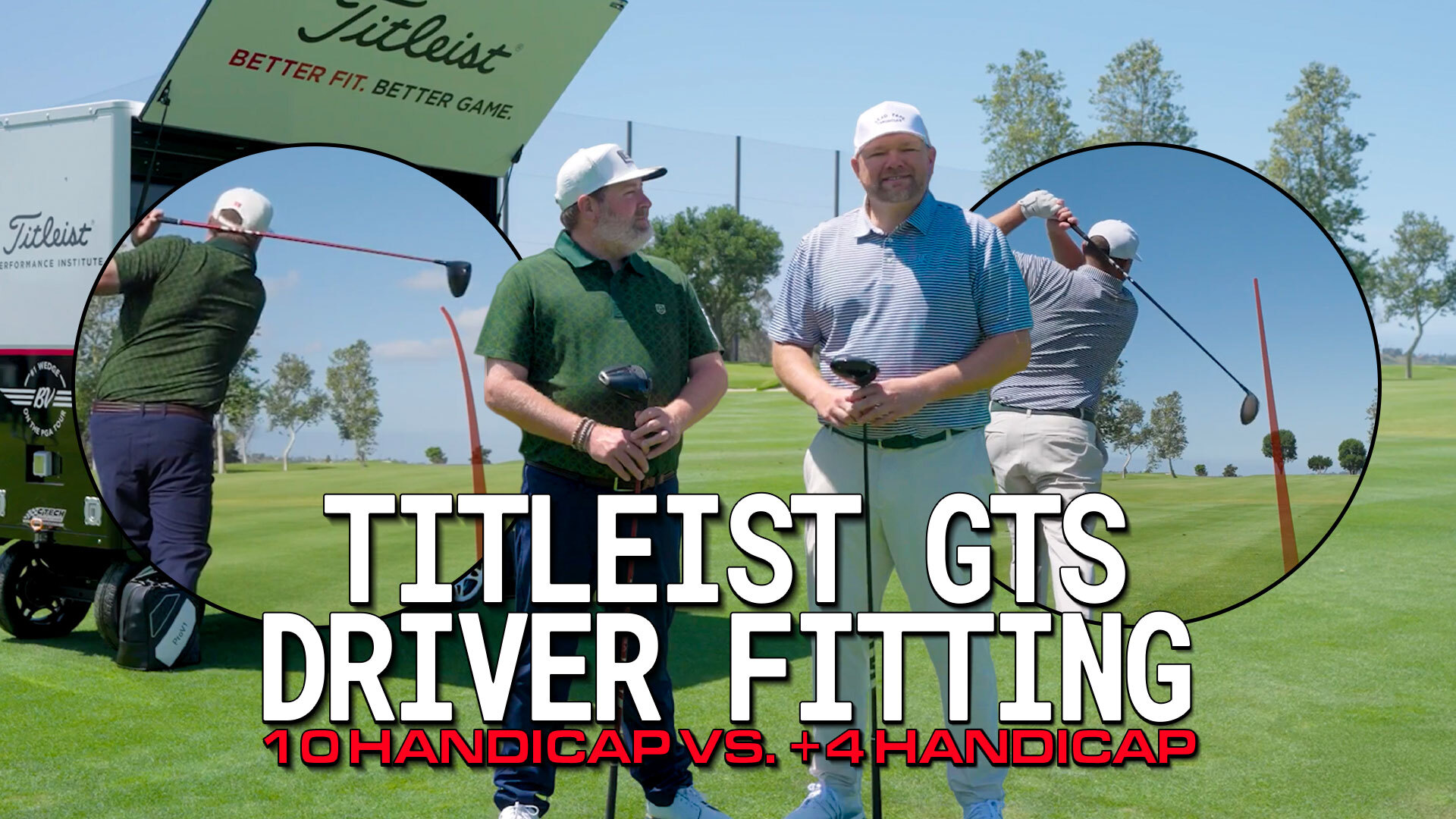
What happens when a 10 handicap and a +4 handicap go through a full driver fitting at one of the most advanced golf performance centers in the world? Brian Knudson and Andrew Von Lossow headed to the Titleist Performance Institute in Oceanside, California, to find out.
Both players go through a complete Titleist GTS driver fitting with the Titleist fitting team to see how swing speed, launch conditions, strike location, shaft profile, and head setup can completely change performance off the tee. Even though the golfers have very different games, the fitting process reveals just how important proper equipment can be for maximizing distance, tightening dispersion, and improving consistency.
You will see how Titleist fitters analyze every part of the driver setup including loft, weighting, shaft selection, and head model to build a driver specifically for each player’s swing. While the skill levels, club head speeds, and desired outcomes are different both players show how deep and versatile the new Titleist GTS driver lineup is.
-
 News3 days ago
Russell Henley’s winning WITB: 2026 Charles Schwab Challenge
-

 Whats in the Bag2 weeks ago
Aaron Rai’s winning WITB: 2026 PGA Championship
-
 Tour Photo Galleries2 weeks ago
Photos from the 2026 CJ Cup Byron Nelson
-

 Equipment2 weeks ago
CJ Cup Byron Nelson Tour Report: Koepka and Kim’s newest putters finally get hot
-
 News5 days ago
Charles Schwab Challenge Tour Report: MacIntyre, Åberg and Spaun all switch putters, TaylorMade launches new Spider
-
 Equipment1 week ago
Details on J.J. Spaun’s surprise putter switch
-

 Equipment8 hours ago
Details on Jason Day’s latest prototype Avoda iron setup
-
 Popular Photo Galleries1 week ago
Photos from the 2026 Charles Schwab Challenge


Dave r
Sep 30, 2019 at 1:32 pm
It all starts at the pro level just watched the Safeway open and fell asleep. Throwing up grass it hits caddie in face still can’t tell which way it’s blowing does this 3 times . Then the pro does it then they discuss the yardage and then the club selection then the wind changed and more talk now the moon has changed the effect of the ocean and it might not be blowing at the green so start again. No wonder it takes two people five hours to play.
Jagged-S
Sep 26, 2019 at 6:18 pm
What is the most wasted time on the course? Looking for lost balls. No-one clocks the allowed 3 minutes and few play a provisional ball. Yes the new local rule, if adopted, helps a little but instead of yakking to your mates and fiddling with your bag, watch other players’ shots and try to fix the position.
cory
Sep 24, 2019 at 9:55 am
If you think the pace of play for a 4 hour round is appropriate, you’re part of the problem.
kevin
Sep 24, 2019 at 2:30 pm
keep raking in those 4 and 1/2 foot gimmies….lol
Matt Schulze
Sep 23, 2019 at 9:44 pm
Keeping a GHIN just to keep off the reds and whites seems excessive. I’m fully capable of shooting 80 from the tips of most courses in my area, but I think I’d be more likely to just stay in my garage with Skytrak than ever go to the course if the alternative was never hitting any longer than a 7i or 8i on a par 3.
4h
Sep 24, 2019 at 5:57 pm
Matt, you’re not the guy anyone’s worried about. But the lack of a handicap is more interesting. Why not have one? What’s so bad about it?
Under 4h
Sep 23, 2019 at 9:28 pm
There’s only one fix needed, and the rest of the world already does it. The US doesn’t need to implement Stableford, but a triple-bogey maximum score would be the single greatest fix to slow play.
Par 4, not in within 6? Write down 7 and GTFO.
If you have a real handicap and know your ESC, no problem. If you’re playing Stableford off your index, no problem. Players with that knowledge are less often a problem.
Speaking of — No GHIN? Forward tees only.
JThunder
Sep 24, 2019 at 1:43 pm
If you think the majority of American golfers will pick their ball up at triple-bogey and walk off the hole, you’ve clearly never met an American in your life.
“I paid good money for this round, and I’m going to get every penny’s worth. That’s my RIGHT! If you don’t like my pace of play, you can go play somewhere else!”
4h
Sep 24, 2019 at 6:01 pm
Considering I am an American, living overseas, I’m fairly positive I’ve seen my share of d1ckheaded Americans getting their slow rounds on.
You might still get those people, but if the scorecard itself has a “Max 7” on it, or whatever… the norms will change. It won’t be overnight, but if playing partners can tell *that guy* “you can’t score any higher; let’s go”, then you start getting pace going.
Hell, they do it at putt-putts. Fairly certain this isn’t that hard. But everyone’s gotta play PGA style…
4h
Sep 24, 2019 at 11:56 pm
As soon as you put on the card a max score, partners will make the point.
JThunder
Sep 23, 2019 at 6:15 pm
A good point – on the one hand, you do have modern life’s expected pace creeping onto the golf course. The number of golfers talking on their cell phones – as if it couldn’t wait – is proof enough.
On the other hand, you had a huge influx of new golfers in the Tiger era, many of whom never learned etiquette and pace… and the golf courses and OEMs were too busy raking in the cash to care.
Courses around me regularly host 5-6 hour rounds, especially on weekends. There is only one root cause for this – not knowing how to keep pace. It starts with entire foursomes riding to each others’ golf balls and watching each others’ shots. It extends to ludicrous putting green behavior.
Professional pace of play is party to blame. More to blame is the lack of instruction and rangers on the courses. On every first tee, rangers should be explaining – NICELY – how to play ready golf.
Golf telecasts do not help – an inordinate amount of time is spent watching putts being lined up, players conversing with their caddies, etc. When there are 70+ playes on the course, a quicker pace of cutting to actual activity would be beneficial.
I can’t help but wonder: those who complain about golf’s pace of play, how the hell do you watch football? Easily the worst ration of action:nothing in the world.
Pat S
Sep 24, 2019 at 12:16 pm
“There is only one root cause for this”
This isn’t entirely true. There are many factors that come into poor pace of play and most of them are not actually controlled by the player. While I agree that players being educated on keeping pace can help… it won’t do any good if the course management sets players up to fail by packing players in at 7 or 8 minute intervals. Courses can be set up with shorter rough and properly marked penalty areas to reduce lost balls. Proper signage on difficult holes can reduce decision time for players.
Rangers can be better educated on what proper group spacing looks like on their course (Proper spacing is different for each hole on each course). Picture this, you’re waiting on a group every shot for 4 holes. Now you have a par 3 followed by a long par 5. By the time you finish up the par 3 and go to tee off on the par 5, the group in front is already at the green. The range comes up and gives you the “your proper place is directly behind the group in front and you need to speed up”. You’ve been waiting on those guys all day but somehow you’re out of position. That’s not true on that hole and speeding you up will do nothing to speed up the round. You’ll just catch up to the group in front faster and wait on them longer. If the ranger knew the course spacing and the tee time intervals were set properly, he’d be able to determine which group was slowing play and help them move along.