
News
A Week Inside the Ropes Part 1

.jpg) If you granted golfers one wish and they could have anything they wanted within the realm of golf, you would likely get a tremendous range of answers.
If you granted golfers one wish and they could have anything they wanted within the realm of golf, you would likely get a tremendous range of answers.
Some might want to play Pebble, others would want to tee it up at Cypress, and many would want to play with Tiger, while others would want to own a handmade Scotty Cameron. However, my wish was always to play in a PGA Tour event and it became a reality in 2001, when I qualified for the PGA Tour’s Genuity Championship, hosted at Doral, in Miami, Florida. I will attempt to share with you my experiences, the good and bad, how I got into the event, and my week inside the ropes.
The years leading up to my qualifying for Doral were challenging ones to say the least. Growing up I was a hockey player, having played for almost 15 years. So golf was foreign to me, and was not what you would call a normal sport where I grew up, falling into it almost on accident. During one of my off seasons, a few of my hockey teammates were going to play and asked if I wanted to go along, I accepted, and the rest is history. I soon fell in love with the game, the challenge and the peacefulness of it, a complete change from the rough, physical, team like aspect of hockey. It was the polar opposite of what I had loved for all of my life, yet I was ensnared by the grasp of this game called golf. I started to play all the time during the summer months in New England, and took some lessons along the way, with one of the club pro’s at Winchester Country Club. This is where I found out about the PGCC, and where I would go to school a few years later.
After graduating from the golfer’s college, I took a job back in New England at Sky Meadow Country Club, one of the finest golf courses in New Hampshire (formerly the number one ranked course in the state). There I started to play some tournament golf in the New England assistant’s association tournament series. I fared well in some events, and played mediocre in others. It was tough because I knew that I was better than my scores, my golf swing was very good, and had the mentality of someone who would never give up. The one area that was lacking was my putting prowess. It would be something that would hinder me for most of my professional career. I then moved down to Florida, and this would be the start of my path toward fulfilling a dream that previously was only that, a far fetching dream.
Late in the year of 1997 I started my tenure at PGA National, where I would work as a cart guy, an assistant professional, and ultimately the first assistant. During those years finding the time to play while working full time was a job in and of itself. Anyone who has worked in the industry knows that maintaining your game is a tremendous challenge and one that you must stay on top of, if you want to be competitive. Luckily I loved playing tournament golf, and the club that I worked at had decent privileges for its employees, not to mention there were always games going around if you wanted some action. So this is where I met some of the guys that would help fine tune my game to the point where I would be able to compete at a high level, high enough to qualify for a tour event.
I played in dozens upon dozens of tournaments over the next few years, winning some, and starting to make a little name for myself down there in Florida. I could shoot a good score at any given time, or I could shoot a not so good score as well. Some of my buddies would be waiting in anticipation to hear of my round after the tournament was over, curious to see if the good Dan or the bad Dan was going to show up this week. It became sort of a joke between me and my closest friends. Luckily I started to get more consistent and post better scores more often than not. I think that this was some of the confidence that led up to my qualifying. A confidence that ones needs to perform at a high level, without it you will get steamrolled by the rest of the good players that are out there. I can still remember the practice sessions with my buddies, out there at 6:00 until dark at 8:45, chipping and pitching, trying to hit the broken picker at 85 yards, or hitting drivers to the back of the Haig range (signifying that you caught it!). These were the good times, and there were plenty of good players down there in Florida when I was there. I can remember hitting balls with Briny Baird or Brett Wetterich, who were good friends with my roommate, and asking them questions all the time (this was before either was on tour). Caddying for my roommate that played on the golden bear tour, just to figure out how they did it and why they could shoot 69 more often than I could. All of these things helped make me a better player, all helping me to qualify for Doral that Monday in the not so distant future. Without the help of my friends, peers, and professionals with regard to my golf game and confidence, this would have never happened.
Forward now to 2001, I was a 29 year old club professional and now a 3 year member of the PGA of America. I was still working at the same upscale resort in West Palm Beach, and was playing tournament golf whenever I could. Most events that I could afford were PGA sanctioned events during the summer months. The winter tournaments in Florida are few and far between, plus it is hard to get the time off because we are in the middle of season and busy with work, lessons, and other job related duties. But by the end of January, season is still in full swing, but you now start to look ahead to the tournament season. This was around the time when the qualifiers for the tour events surface and you start to prepare for them.
I was still known as an underachieving player, a lot of talent but never seemed to put it together for long stretches. I would win an event one week, and next week I would miss the cut or shoot 79. But 2001 was different for me. Following up a great 2000 season, I had some great rounds at my home track during the off months, even shooting a career low round 63, with two bogeys. I had continued to develop my new approach to the game, information that I continued to receive from some of my mini tour friends, and then reaffirmed with my more consistent play. I would continue to caddy for them from time to time, to see what they did better than what I did in tournament play. They were proponents of eliminating one side of the course, telling me, “Eliminate half the course, and your scores will drop”. So I was on a mission to approach the game in another way, a way to figure out how to eliminate one side of the course, and the shot shape that would allow me to do that. I had been working on this aspect of my game for a year or so and in late ‘99 things were really getting good, and then in early 2001, I was shooting great scores more often and my game steadily becoming very consistent. Left to right it was, I just found it easier to do and like Hogan said, “You can talk to a fade, but a hook does not listen”.
The Monday qualifier for Doral was just around the corner and I had a great schedule at work that week. I was able to play every other day, and on Sunday before the qualifier. So I figured I would be firing on all cylinders going into the qualifier, and indeed that was the case. I shoot 69, 63, 68, 67 during the previous two weeks, and a late afternoon nine of 34 on Sunday night, after an impromptu putting session just before the qualifier the day before. So Monday morning comes around and the weather is perfect, a little chilly to start the round, and then it proceeds to warm up nicely and the wind is picking up, getting gusty up to 20 mph. To make a long story short, I shoot 70 and wait in the clubhouse for about 3 hours. During that time I managed to consume my fair share of Beam and Cokes, and if a playoff had in sued, I would have been useless. I also was able to analyze my round and figure out that I really played well and eventually hung on to shoot the score that I did. Had it 4 under on the front nine and was cruising along, and then hit a small road block on the back with a double on the 15th hole. Somehow I managed to get it into the clubhouse, getting it up and down from no where on 17, and then two putting on 18 from about 50 feet. I was drained mentally, and the post round beverages were going, so lucky for me a playoff did not happen. Then the last really strong player came in from the final group and he had shot 73, I had actually done it; I qualified for the PGA tour event at Doral. It was that single most important thing that I had done in the game of golf up to that point.



Despite Colin Jost being so over the expression That was not on my bingo card, so much of what happened on Saturday at Riviera was precisely defined by that 2026 catch-phrase. Seasoned professionals faltered while young amateurs soared. Leaders posted par rounds while afterthoughts amassed birdie after day-three birdie. What transpired set up the potential for the best duels in USWO history. In the mixing bowl are the world’s number one, former champions, former contenders, and a host of the game’s top names.
Over the first three days, Riviera has played more like a golden-age gem than it ever has in modern times. Players are using greenside slopes and fairway cambres to propel the ball into proper position. Green speeds are manageable, yet daunting from the absolute worst place (read: above) in relation to the hole location. Nothing is unfair (fingers crossed for the same in two weeks on Long Island) and everything is earned.
Could it be Nelly, or Charley, or Sei Young or In-gee? How about Gaby or Jennifer, Nasa or Ruoning? All have contended before in the U.S. Women’s Open, but only In-gee Chun has raised the Semple trophy in triumph. A Hollywood sound stage is set for a dramatic finish, but prior to the conclusion, let’s revisit the five things that we learned on Saturday at the U.S. Women’s Open.
Saturday Thing One: Nelly Korda is tied at the top
If it were anyone else, after consecutive rounds of 67, the dam would break. That’s not the case with Korda. If anything, we expect that she might go lower on Sunday, to the tune of 65, and walk off with her first U.S. Women’s Open title.
We know that ruling bodies and host clubs adore name champions. They salute all victors, but the success of a current top golfer, a media darling, or a proven veteran serves to legitimate and venerate the event and the venue. The USGA and Riviera would be thrilled to have Nelly Korda as a champion.
What will propel the three-time major titleist to a fourth grand slam victory? Another 67, for starters. Reaching double-digits under par would place the Floridian in a marvelous space. It would require Sei Young to keep pace, and would demand that all the trailers post 66 or better.
Saturday Thing Two: How about those amateurs?
1 2 3 5 6 10 13 16 17 18
Those are the holes that Maria Jose Marin (68), Aphrodite Deng (68), and Asterisk Talley (66) birdied on Saturday. That’s a minus-ten ringer score for the trio. As we sleep one more sleep before the final round, consider that Marin and Deng are four strokes back of the leaders, while Talley is five shots behind. To have three amateur golfers within striking distance of the top ladder rung is heady stuff. Can Talley possibly follow up her minus-five with another one on Sunday? Even that might not be enough. How about Marin and Deng. Can they drop a mid-60s scorecard on the professionals, and throw a scare into them? Our intuition suggests no on both counts, but the potential for a top-five amateur finish is certainly in the cards.
Saturday Thing Three: the Korean Kontingent
Sei Young Kim and In-gee Chun would win any partner event this week, given their current form. Kim will tee off with Nelly Korda in the last game, and she will have a front-row seat to Chun’s performance, as In-gee will play in the game just ahead. Of the two, Sei Young appeared to have less control over her shots, as a substantial number of spproach shots turned inordinately left.. Time and again, her short game bailed her out of the bogeytown prison, although she did miss a fair number of short putts. Dumbo (aka Chun) seemed more in control from tee to green, but will need to channel her early-2020s self to insert herself into the narrative.
Saturday Thing Four: Kupcho’s Komeback
It’s not like she went very far away, but Jennifer Kupcho’s 69 on day three had to be gratifying. The Colorado native and Wake Forest alumna was in fine Friday position to make a statement and expand her lead. She had posted 66 on Thursday, but fell off form on day two with 73. There were 67s and 68s at Riviera that day, but Kupcho’s birdie production fell from seven to two, as her bogey line increased from two to four. She reduced the bogey output on Saturday, and redoubled birdies to four. She finds herself precisely one shot off the lead, in a tie with In-gee Chun, her Sunday walkabout mate.
What will Kupcho need on day four, to provide an opportunity for victory? Fairways and greens always help, but that electric, day-one start of birdies on holes one, two, and three will be massive. Stay on the proper side of the green-center bunker on six, and survive the dautning holes. Kupcho has made bogey on 13 and 15 twice in three days. Should she come to the final stretch in a place of power or hope, those two holes will test her worth and mettle. Kupcho has also played the closing triumvirate of holes in par or better, each of the three days. That sort of clutch-time performance will stand her well on day four.
Saturday Thing Five: How will it all transpire?
No one expects that both of the top two will struggle on Sunday. One of them will shoot 68, to reach nine-under par. That means that the trailers will have to light up the western sky with fireworks, to keep pace. There is a golfer with nine, top-ten finishes in major championships, who has never won a major. That golfer is Nasa Hataoka, and she is poised to break through and make a victory out of her tenth, top ten finish at a major. Hataoka finished T2 and T4 in this event in, respectively, 2021 and 2023. A missed cut in 2025 was a shock to the system, but the Japanese golfer will bounce back in style and claim the title.
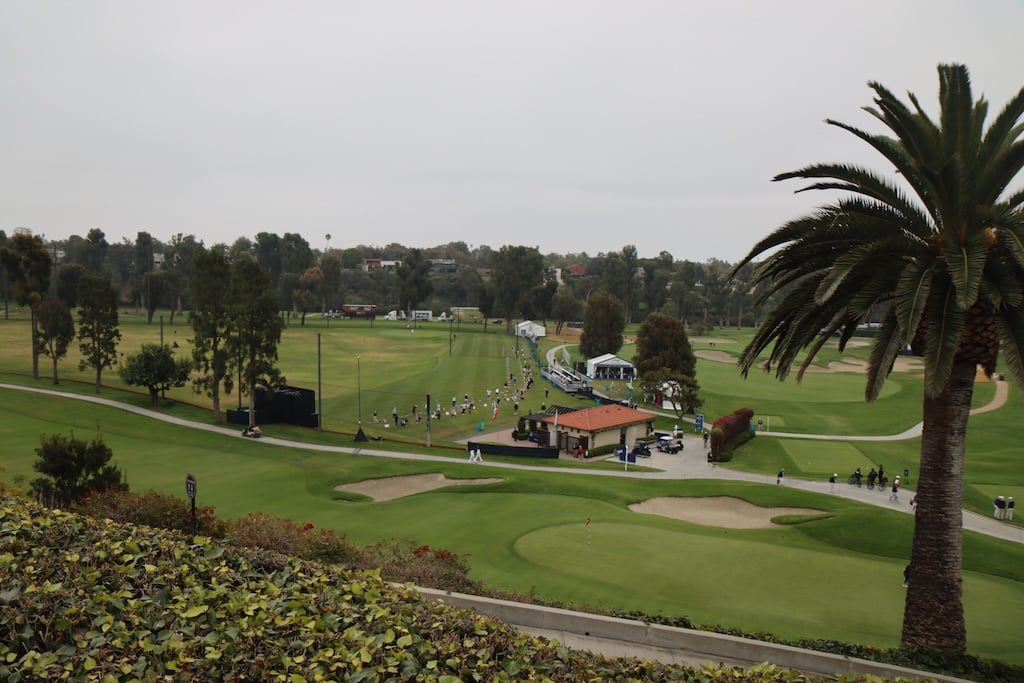
Dumbo flies again! There is certainly a half-generation of golf fans without the slightest idea of how well In-gee Chun, aka Dumbo, can golf her ball. The Korean was the It Girl from 2015 to 2018. She won three LPGA events, with two being major championships. She returned to Korea to cure her homesickness, but made the occasional foray back to the Americas. In 2022, she captured a fourth LPGA title and, guess what? It was a third, unique major title.
The halfway cut line was set at four over par. Those at plus-five and beyond had their stay in Tinseltown cut short, at least when it comes to working rounds of golf. Among the 87 who fell on the high side of the cut line, Lydia Ko stood out as the biggest name. Others given a two-day furlough were Lilia Vu, Megha Ganne, Chizzy Iwai, and Leona Maguire. Making the cut on the number are Lottie Woad, Celine Boutier, Mao Saigo, and amateur Asterisk Talley. If you follow world football, imagine the feeling of relegation on a weekly basis. That’s the 36-hole cut in professional golf.
We learned five things on Friday at Riviera Country Club, and we’d love to share them with you. Find a comfy place and brighten the screen on your device. It’s time for Five Things We Learned on day two at the US Women’s Open.
Part One: the biggest movers
A golfer’s feel appears or slips away overnight. Although Saturday is known collectively as Moving Day, it doesn’t come with as sudden and final a feeling as Friday. Move the wrong way on Friday and you’re down the road. Improve in the proper direction and you save your week. Both Mao Saigo and Rio Takeda opened with plus-five rounds of 76, then signed for 70 on day two, and made the cut on the number.
Moving the other way were Stephanie Kyriacou (70-78) and Ina Yoon (68-79). Their respective eight- and eleven-shot declines propelled them from title contention to tournament departure. Minjee Lee and Minji Kang (seven shots higher) along with Rose Zhang (five shots) made the cut, but saw their opportunity for victory take a serious body shot.
Part Two: the leaders
Allison Lee and Ruoning Yin took the conservative path to the 36-hole medal. Lee posted four birdies and a bogey for a total of 68 on day two. Yin had two birdies and sixteen pars for her second consecutive card of 69. Their 138 places them one shot clear of the aforementioned Dumbo Chun, who followed an opening 71 with 68. First-round leader Jennifer Kupcho added seven shots to her total, from an opening-day 66 to a follow-up 73, yet remained within the inner circle of leaders at -3, tied with Chun and four others. Four more golfers sit at minus-two, two shots behind the top duo. An even dozen of golfers sits within two shots of the lead.
The day’s biggest move of gravitas came from Nelly Korda. After a disappointing 73 on Thursday, the world number one improved six shots, thanks to a five-birdie round of 67. Korda slid inside the top ten with her recovery, and certainly reclaimed her place as most frightening chaser at Riviera. No one is likely to shoot in the low 60s at Riviera, but Korda just might post a mid-sixties score on Saturday, to seize the lead on Sunday morning.
Part Three: Ams verse Champs
Five current amateur golfers were among the 68 golfers to reach the weekend. Kiara Romero posted the best non-pro score on Friday, a one-under 70, to move from plus-two to plus-one figures. She is joined there by Aphrodite Deng, who reversed those numbers for her two rounds. Maria Jose Marin (143), Farah O’Keefe (145), and Asteriks Talley (146) joined the #WeDidIt brigade to earn a spot for the final two rounds.
Six former US Open champions, led by In-gee Chun(2015), also punched a ticket for round three. Allison Corpuz (2023), Maja Stark (2025), Ariya Jutanugarn (2018), A Lim Kim (2020), and Minjee Lee (2022) preserved their dream of a second US Open trophy for the mantle. Nineteen amateurs failed to earn a post for the final 36-holes, while five former champions joined them on the sidelines. Yuka Saso, twice a winner in this event in the past half-decade, missed the cut by five shots. 24 amateurs against eleven former titleists suggests that it is easier for the young to qualify, but harder for them to find success.
Part Four: the golf course
Scoring went up by .6 shots per player, from round one to round two. Statistically speaking, it became harder to make the cut as the day wore on. Birdies dropped by 50, while pars remained constant. Both bogeys and doubles increased markedly. The first and the sixth holes played under par on the front nine, while the second and ninth were nearly tied for most difficult traces on the road to the turn.
Coming home, holes ten, twelve, fifteen, and eighteen played as an impregnable quadrilateral. Odds are, you gave a shot back on each of them. Despite number seventeen’s accessibility for birdie, no one got out of the back nine alive. If conditions continue toward the extreme, Riviera will extract a pound of flesh from the contenders over the weekend.
Part Five: what to expect
From my vantage point, the tee times to watch are the 4:55 EST and the 5:05 slots. Nelly Korda pegs her ball in the sixth-last pairing with Sora Kamiya. The little-known Kamiya will get an up close and personal look at the crowds that follow the best in the world. Korda will need to ignore Kamiya’s expected struggles and golf her own ball. Ten minutes later, Lauren Coughlin begins play with Casandra Alexander at her side. It’s a similar situation, with the experienced Coughlin alongside an unseasoned partner.
Both Sei Yong Kim and Gaby Lopez have turned in strong performances, and their 5:15 pairing might produce some explosive numbers. From back in the pack, the tasty duo of Brooke Henderson and Jeeno Thitikul at 4:20, might see double digits in birdies. The unexpected at unknown Riviera is likely, so your guess is as good as mine.
Gone are the days when the U.S. Women’s Open was held at Scenic Hills or Churchill Valley. Fine courses that they are (or were, as Churchill Valley went bankrupt a decade ago) there is something to be said for the venue. Not all Women’s Open playings need to take place on Men’s Open venues, but some should. This week in Los Angeles, the Women’s Open visits Riviera Country Club for the first time. Down the road, we will visit Inverness, Oakmont, Interlachen, Oak Hill, Chicago Golf, and Merion. That is quite the murderer’s row (1927 Yankees reference) of golf clubs.
What can we expect from the 2026 tournament? Greatness and uncertainty. Unlike the PGA Tour, which visits Riviera each February, the LPGA does not, so the women will not have nearly the body of work over the George C. Thomas layout. Maybe that’s a good thing. Maybe they’ll play #10 smarter than the men do. Maybe they’ll figure some things out that their male counterparts can not. For today, we’ll try to find five things to learn, and share them with you.
First, this ain’t your momma’s U.S. Open course
How do we know? Well, so far, only one previous champion currently sits inside the top thirty. That would be Minjee Lee, the 2022 winner at Southern (NC) Pines. Lee made par on her first nine holes, the inward side at Riviera. She dropped birdie putts on the first and ninth holes (ten and eighteen for her day) and tallied another seven pars, for 69. She sits three shots off Jennifer Kupcho’s opening 66. Don’t worry about Kupcho; we’ll get to her. After Lee, defending champion Maja Stark ranks T30 at even par, joined by three other, former winners.
What Minjee did, is the sort of thing that wins U.S. Open titles. She guided her ship safely past swells, and made a move when the waters calmed. The fewer the bogeys, the more likely Minjee figures in the outcome on Sunday evening in Pacific Palisades. Off the tee, Lee was unmatched. She hit 14 of 14 fairways. Her iron play was a bit loose in comparison. She putted for birdie on 12 of 18 holes, which meant that her recovery short game was on point. Lee was ten yards longer on measured driving holes than the field average, and was below the field average (a good thing) in putting.
Second, the amateurs beat a loud drum
Three of the world’s top amateur golfer posted 70, placing them four off the lead, in a tie for 14th place. Canada’s Aphrodite Deng, Spain’s Paula Francisco Llaño, and Colombia’s Maria José Marin, showed the professional world that their game is strong. Both Deng and Francisco Llaño collected five birdies on the day. Should they match that output on day two, and minimize the foozles, they’ll be the topic of conversation on Saturday morning. Marin, the 2026 Augusta National Women’s Amateur champion and an NCAA team semifinalist last week, played a game similar to Minjee Lee: few mistakes and few taken risks.
The last amateur to post the low medal score for 72 holes was Jenny Chuasiriporn in 1998. She lost a playoff to Se Ri Pak, who matched her plus-six effort at Blackwolf Run. The last amateur to win the U.S. Women’s Open was Catherine Lacoste in 1967. The amateurs are stronger than they’ve ever been, but the professionals have not allowed them to close the gap. A victory by one of the college set would be a cannon shot heard round the world. Could it happen? Absolutely. Is it likely? Not at all.
Third, let’s talk Kupcho
Jennifer Kupcho won the inaugural Augusta National Women’s Amateur. She won three times on tour in 2022, including the Chevron, a major title. She won a fourth event in 2025, but has not established the winning credentials projected on her after 2022’s marvelous coming-out.
Kupcho hails from Colorado, and spent four years in the Carolina Piedmont, at Wake Forest Universtiy. Neither of those locales cries out I’ll be at home at Riviera, but here we are, after a seven-birdie performance. Kupcho posted birdie on each of her first three holes, and added four more (against two bogeys) to assume a one-shot advantage over Korea’s Sei Young Kim.
Kupcho drove the ball decently, approached moderately well, but putted lights out on Thursday. Her 26 putts were tied for best in show on day one. There might just be something about the putting surfaces at Riviera that aligns with Kupcho’s vibe. If that is the case, just get the ball on the green, anywhere, and let the flatstick do the lifting.
Fourth, how young is Sei Young?
Sei (pronounced “So”) Young Kim won a dozen times from 2015 to 2020. She took time off from winning until 2025, shen she captured a thirteenth LPGA title. Like Kupcho, Kim has hardware from one major event, the 2020 Women’s PGA Championship. How to explain the five years away from victory? No idea. When Sei Young was in contention during the prime of her career, the outcome was a foregone conclusion.
What to expect over the next three days at Riviera? Anyone’s guess. It might be the 2015-2020 Sei Young, or it could be the 2021-2025 version. Kim began her day with birdies at 10 and 11, then settled into a stretch of pars before her solitary bogey at the 4th (her 13th) hole. Kim regained her composure and reeled in three birdies to close the front nine. Her four-under performance trails Kupcho alone, and there is a real chance that Sei Young will produce a second score in the 60s and take a bit of control of the tournament.
Fifth, we’re giddy for Gaby
Although I cannot place my finger on why, it seems that each year, Gaby Lopez pops up on the U.S. Open leaderboard. She hasn’t figure out how to remain in contention, but here we are, in 2026, and Lopez is once again in the mix. The three-time champion on the LPGA circuit had a stunning first nine holes, turning in minus-five. She reached six deep at her tenth hole, but then gave three shots back coming home. Which Gaby will show up on Friday, and for how long? If back-nine Gaby can somehow channel front-nine Gaby, all outcomes are within reach. If the loose play continues, Lopez’ wiki page will add one more T41 to her majors column.

Justin Rose WITB 2026 (April): Full WITB breakdown with new McLaren irons

What’s the story behind Webb Simpson’s custom-stamped irons?

Cadillac Championship Tour Report: Spieth’s sizable changes, McLaren Golf launches, and more

Memorial Tournament Tour Report: Rory McIlroy, Cameron Young switch up drivers, and more

Russell Henley’s winning WITB: 2026 Charles Schwab Challenge

Kristoffer Reitan’s winning WITB: 2026 Truist Championship

Aaron Rai’s winning WITB: 2026 PGA Championship

Cameron Young’s winning WITB: 2026 Cadillac Championship

Details on Jason Day’s latest prototype Avoda iron setup

Justin Rose on the switch to McLaren Golf, learnings from previous equipment moves

J.T. Poston’s winning WITB: 2026 Memorial Tournament
Driver: Titleist GTS3 (9 degrees) Shaft: Mitsubishi Diamana BF 60 TX 3-wood: Titleist TS2 (15 degrees) Shaft: Graphite Design Tour...

Alex Noren WITB 2026 (June)
Driver: Callaway Paradym Ai Smoke Max D (9 degrees @7, draw setting) Shaft: Graphite Design Tour AD VF 6 X 3-wood: Callaway...

Melanie Green WITB 2026 (June)
Driver: TaylorMade Qi4D (9 degrees) Shaft: Graphite Design Tour AD VF 5 S 3-wood: TaylorMade Qi4D (15 degrees) Shaft: Graphite Design Tour...

Sungjae Im WITB 2026 (June)
Sungjae Im had >14 clubs in his bag when photographed prior to the Memorial Tournament. Driver: Titleist TSi2 (8 degrees, B1...
-
 Equipment3 days ago
Memorial Tournament Tour Report: Rory McIlroy, Cameron Young switch up drivers, and more
-
 News1 week ago
Russell Henley’s winning WITB: 2026 Charles Schwab Challenge
-
 Equipment5 days ago
Details on Jason Day’s latest prototype Avoda iron setup
-
 Tour Photo Galleries3 weeks ago
Photos from the 2026 CJ Cup Byron Nelson
-

 Equipment2 weeks ago
CJ Cup Byron Nelson Tour Report: Koepka and Kim’s newest putters finally get hot
-
 News1 week ago
Charles Schwab Challenge Tour Report: MacIntyre, Åberg and Spaun all switch putters, TaylorMade launches new Spider
-
 Equipment2 weeks ago
Details on J.J. Spaun’s surprise putter switch
-
 Popular Photo Galleries2 weeks ago
Photos from the 2026 Charles Schwab Challenge


Dan G
Sep 24, 2007 at 5:40 pm
Thanks JD,
The second part of the story will be out here soon. That is where the good stuff is.
And yes I have played some great golf, won tournaments, shot so many rounds in the 60’s I cannot count them anymore, and I really did not even sniff a life on the tour. Just shows you the depth on the mini tours, pro tours, and in golf in general.
There was a stretch where I could have made a run with some backing financially. But those days are long past.
John Dortmunder
Sep 24, 2007 at 5:22 pm
and Dan, congrats on this fine accomplishment, I’m sure you’ve had other good results as well…
JD
John Dortmunder
Sep 24, 2007 at 5:21 pm
To me the moral of this story is there are SO MANY INCREDIBLE players in Florida that you’ve never heard of, not to mention the rest of the U.S., that anyone who is critical of mid/lower level Tour players and categorizes them as “journeymen” just doesn’t know WTF they are talking about.
Every player who’s ever even attained a full-time card on the PGA Tour is a world class player ball striker regardless of if they ever do anything else in their career…the defining items at that point are typically putting and/or minset. Zach Johnson will readily admit that his caddy Damon Green is a better ball striker than he is!! (Damon had his card in about 1993 or so)
JMO.
JD
Dan G
Sep 20, 2007 at 5:06 pm
PGCC is the Professional Golfers Career College. It was very popular when I went to school in the early 90’s as there were not many golf management programs out there.
Mike Lane
Sep 20, 2007 at 3:13 pm
What is the PGCC?
M Anderson
Sep 20, 2007 at 6:48 am
Awesome! Can’t wait to read the next instalment.