
Opinion & Analysis
Checking the numbers: Going For It On Par 5’s

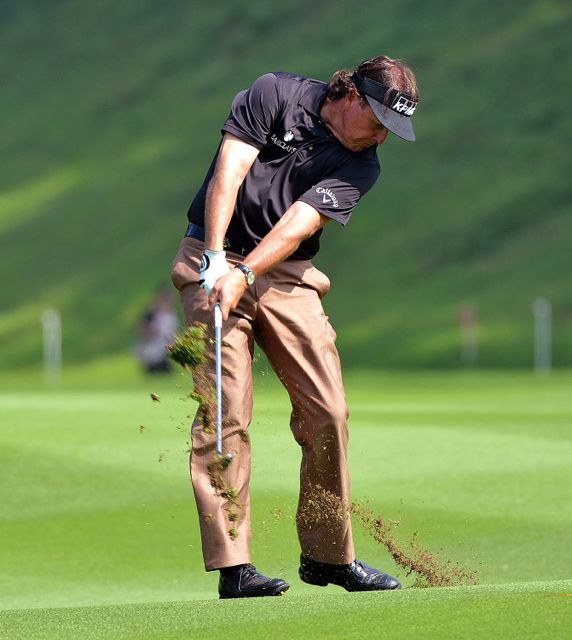
Every golfer is faced with the dilemma of whether to go for a par 5 on the second shot. I always questioned the validity of being aggressive on the par-5’s versus laying up. As my game improved as a junior golfer and collegiate golfer, I started to notice more golfers laying up on par-5’s in order to have a certain distance into the green where they felt comfortable taking a full swing into the flag.
In my statistical research, one of the glaring observations was that longer players on the PGA Tour have a strong correlation to par-5 scoring average. As I investigated this further, it became very simple to understand. Longer players on Tour typically had a higher percentage of “go for it” on par 5’s. Thus, in my mind they were playing the par-5s more like a long par 4’s.
I also started to notice that some of the average and even shorter hitters on Tour could play the par 5’s quite well each year such as Bill Haas, Kevin Na, Webb Simpson and Steve Stricker. When I looked at these players who are not incredibly long off tee, but played well on the par 5’s, I noticed that they were going for par 5’s in two shots at a higher rate than golfers of similar driving distances and club head speeds.
This led to me trying to understand how “going for it” was defined by the Tour’s ShotLink data:
“A player is assumed to be going for the green if the second shot lands on or around the green or in the water. Note: ‘Around the green’ indicates the ball is within 30 yards of the edge of the green.”
The last note is very important to understand. If the ball on the second shot ends within 30 yards of the edge of the green, the ShotLink considers that a “go for it.” Thus, if a golfer has a 300-yard shot to the hole and he hits his 3-wood 250 yards, that could be considered a “go for it” as long as the ball is within 30 yards of the edge of the green.
I would imagine that a Tour player who knows he hits his 3-wood off the ground 250 yards onto a 300-yard shot would not consider himself to be “going for it.” However, since it would technically count as a “go for it,” that could infer that Tour players (and golfers in general) are better off advancing the ball closer to the hole rather than laying up to a certain yardage in order to get a full swing on the third shot.
I also wanted to look up the Tour averages of proximity to the cup on shots from various wedge distances.
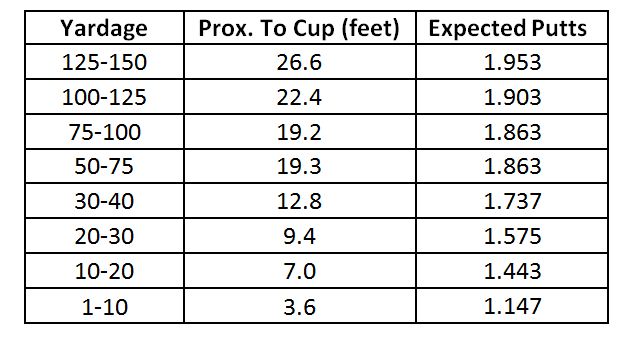
As I wrote in my 2012 Pro Golf Synopsis, there are “many long held axioms in the game have some validity.” If we look at the average proximity to the cup on shots from 50 to 75 yards versus shots from 75 to 100 yards, they are virtually the same. Thus, the fear of not having a full-wedge swing into the approach shot is reasonable. But once the golfer can get inside 50 yards, the average proximity to the cup is dramatically closer.
The expected putts data comes from the Tour. Hypothetically, we could state that the golfer who is laying up will end up somewhere between 50 to 125 yards in order to get that full-wedge swing into the hole and the going-for-it golfer will end up somewhere between 1 to 40 yards from the hole. If we average the expected putts, we come up with the going-for-it golfer expected to have 0.42 fewer strokes. That may not sound like much, but the difference on Tour is worth roughly 30 to 50 spots on the scoring average rankings.
Of course, it is not quite that simple. There is more math that needs to be done with regards historical data with regards to how players played that particular hole and their scores and other mitigating factors like the golfer’s skill sets, potential hazards, etc. It does give a good indication of where the concept of laying up to get a full wedge swing stems from; the inability to hit it closer from that mid-range of 50 to 75 yards. However, if the golfer can get the second shot within 50 yards, he is most likely much better off at going for greens in two shots.
Click here for more discussion in the “Tour Talk” forum.


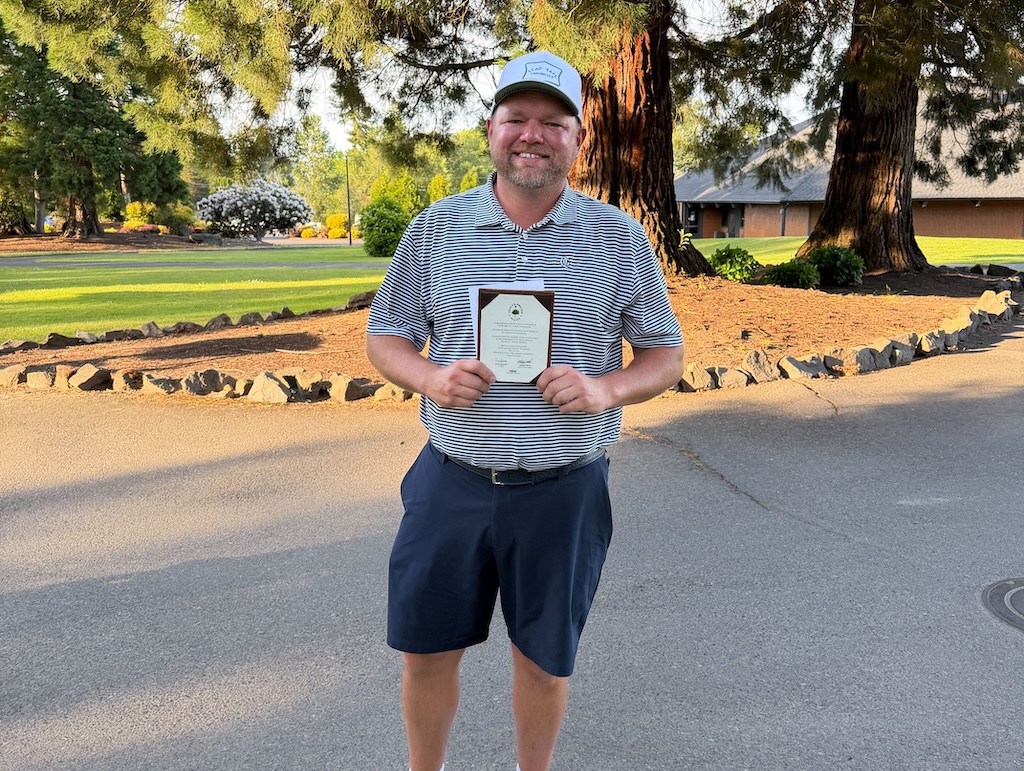
This past Monday, I played in the U.S. Amateur local qualifier at Rock Creek Country Club in Portland, Oregon. A full tee sheet from 7:30 a.m. to 1:55 p.m., the top 11 scores would make it to the U.S. Amateur final qualifying.
I teed off at 10:48 a.m.. With the 7:30 am tee time, you can get a feel for the leaders’ pace, and they were off and running on the challenging setup at Rock Creek.
View this post on Instagram
Getting to the highlight of the round on the par five 17th, a drive up the left side and 212 yards left to the front hole location. I took out a 5-iron with plans of middle of the green. The ball ended up 8 feet left of the hole, pin high. A slight downhill putt dropped in for an eagle 3 on the 17th. With the cut line looking to be anywhere from -2 to even par. This was the boost I had been waiting for all day.
With making par from the trees on 18, it was time to wait for a potential playoff with a posted score of one under par 71.
Three hours later, it was playoff time. 8 players for 6 spots. I made par on the playoff hole, which was good enough to advance to the U.S. Amateur final qualifying in July. USGA qualifiers sure deliver on all of the emotions in golf!
Club Junkie
Building my 2026 gamer WITB: Ranking the contenders and new putter projects – Club Junkie Podcast

The annual What’s In The Bag build is underway, and on this episode of Club Junkie, Brian breaks down the clubs currently leading the race for a spot in his 2026 gamer setup. From drivers and fairway woods to irons, wedges, and shafts, he ranks the equipment that’s performing best and explains what’s separating the front runners from the rest of the field.
Brian also heads into the workshop to discuss several putter projects currently on the bench. From head options and shaft choices to build ideas and testing plans, he shares what he’s working on and which putters could become serious contenders for the bag this season.
If you’re a gear junkie who loves equipment testing, club building, and the never-ending pursuit of the perfect setup, this episode is for you.
Follow Club Junkie:
Instagram: @clubjunkiepod
TikTok: @clubjunkiepod
Threads: @clubjunkiepod
X: @ClubJunkiePod
Club Junkie
Tour Edge Exotics mini driver review + TaylorMade Spider ZT Max first look – Club Junkie

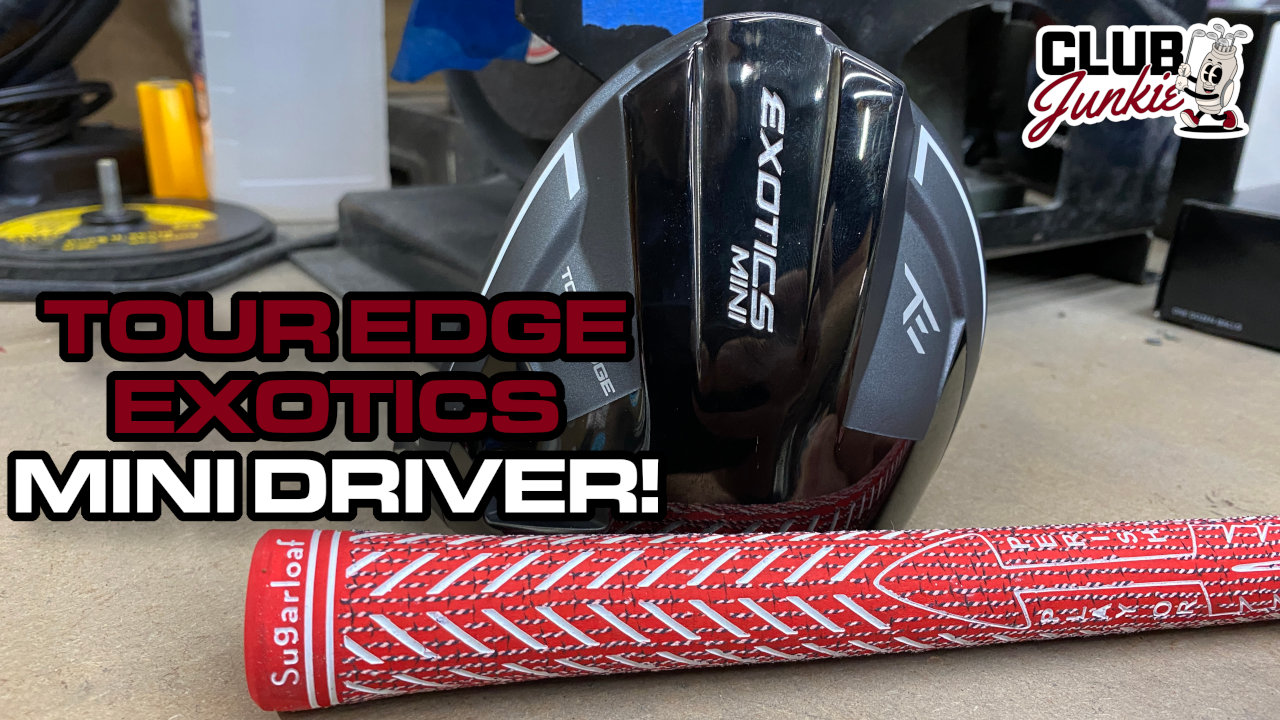
On this episode of Club Junkie, I put the new Tour Edge Exotics Mini Driver to the test and break down the performance, forgiveness, distance, and where it fits compared to a traditional driver or strong fairway wood. If you have been curious about adding a mini driver to the bag, this one is worth a look.
I also dive into the new TaylorMade Spider ZT Max putter that was recently spotted and discuss the growing zero torque putter trend. Plus, there is a closer look at the new Project X Titan Yellow shaft showing up on the PGA Tour and what makes it different from other profiles currently out there.

Justin Rose WITB 2026 (April): Full WITB breakdown with new McLaren irons

What’s the story behind Webb Simpson’s custom-stamped irons?

Cadillac Championship Tour Report: Spieth’s sizable changes, McLaren Golf launches, and more

Memorial Tournament Tour Report: Rory McIlroy, Cameron Young switch up drivers, and more

Russell Henley’s winning WITB: 2026 Charles Schwab Challenge

Kristoffer Reitan’s winning WITB: 2026 Truist Championship

Aaron Rai’s winning WITB: 2026 PGA Championship

Cameron Young’s winning WITB: 2026 Cadillac Championship

Details on Jason Day’s latest prototype Avoda iron setup

J.T. Poston’s winning WITB: 2026 Memorial Tournament

Athena Singh WITB 2026 (June)
Driver: TaylorMade Qi4D (10.5 Degrees) Shaft: Fujikura Ventus Blue 6 S 3-wood: TaylorMade Qi10 Max (16 Degrees) Shaft: Fujikura Ventus Red 6...
J.T. Poston’s winning WITB: 2026 Memorial Tournament
Driver: Titleist GTS3 (9 degrees) Shaft: Mitsubishi Diamana BF 60 TX 3-wood: Titleist TS2 (15 degrees) Shaft: Graphite Design Tour...

Alex Noren WITB 2026 (June)
Driver: Callaway Paradym Ai Smoke Max D (9 degrees @7, draw setting) Shaft: Graphite Design Tour AD VF 6 X 3-wood: Callaway...
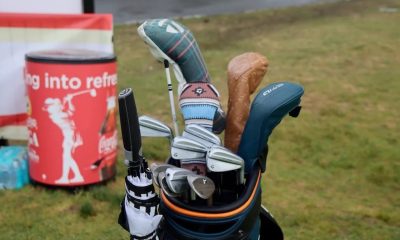

Melanie Green WITB 2026 (June)
Driver: TaylorMade Qi4D (9 degrees) Shaft: Graphite Design Tour AD VF 5 S 3-wood: TaylorMade Qi4D (15 degrees) Shaft: Graphite Design Tour...
-
 Equipment4 days ago
Memorial Tournament Tour Report: Rory McIlroy, Cameron Young switch up drivers, and more
-
 News1 week ago
Russell Henley’s winning WITB: 2026 Charles Schwab Challenge
-
 Equipment6 days ago
Details on Jason Day’s latest prototype Avoda iron setup
-
Whats in the Bag1 day ago
J.T. Poston’s winning WITB: 2026 Memorial Tournament
-

 Equipment22 hours ago
Best irons 2026: Best irons overall, most forgiving irons, and more
-

 Equipment3 weeks ago
CJ Cup Byron Nelson Tour Report: Koepka and Kim’s newest putters finally get hot
-
 News2 weeks ago
Charles Schwab Challenge Tour Report: MacIntyre, Åberg and Spaun all switch putters, TaylorMade launches new Spider
-
 Equipment2 weeks ago
Details on J.J. Spaun’s surprise putter switch


ABgolfer2
Feb 8, 2013 at 6:25 pm
“Every golfer is faced with the dilemma of whether to go for a par 5 on the second shot.”
Isn’t the average male driving it about 220 yards? When would they ever be faced with this dilema on a full length course? Some of the guys I play with are faced with the decision to go for most par 4s in two.
Flip4000
Feb 12, 2013 at 11:41 am
Well ABgolfer2 , if he is playing from the correct tees for his ability and not the tees for his ego, there is still probably a good chance he may face that dilemma at least once a round
ABgolfer2
Feb 12, 2013 at 1:50 pm
Yeah, I know golf is trying to be inclusive and all, but a 380 yard hole is not really a par 5 now is it?!?. 400 yards, let alone 500, is out of reach for most golfers. That’s what I was saying.
Troy Vayanos
Feb 8, 2013 at 4:37 pm
It’s interesting statistics on par fives Rich.
I think for the professionals a lot depends on what is around the green in their decision to go for it or not. For me personally i’m always looking at either hitting it on or giving myself a 100 yard or in distance for my third.
Philip
Feb 8, 2013 at 11:06 am
I find this interesting because we do often hear, “… laying up to a comfortable distance.” A bad shot from 100 yards to most pros is 20 feet yet, that is the average from that distance. Instead of pulling a 7 iron to lay it up, perhaps we should be pulling a 5 iron…
Mateo
Feb 8, 2013 at 1:49 am
zzzzzzzzzzzzzzzzzzzzzzzzzzzzzzzzzzzzzzzzzzz
I really wish someone who could break 80 wrote this.
Martin Chuck
Feb 16, 2013 at 12:03 am
Mateo, I’d bet my house Rich would thump you 5 and 4 and that is if you are a good player. Rich Hunt is a fine striker and very good player.