
Opinion & Analysis
The real numbers behind driving the ball on Tour

By Rich Hunt
GolfWRX Contributor
In the era of modern technology, advanced fitness regimens and long driving competitions, there has been a growing sentiment towards golf favoring the ‘bomb-n-gouge’ style of play. However, we still see many shorter-hitting golfers like Zach Johnson who are successful in the game. Most of the clients on Tour I work with have questioned the advantages that power can have on Tour versus hitting the ball the more accurately. As a competitive amateur golfer myself, it was one of the first things I investigated from a statistical standpoint.
Part of the issue deals with the main metric designed to determine driving skill on Tour, called ‘Total Driving.” Total Driving utilizes a very simple formula by adding the rankings of a player’s Driving Distance and Fairway Percentage together. The lower the combined ranking, the better the golfer will rank in Total Driving. But it’s metrics like Total Driving that have only produced more questions than answers for golfers.
The main issue with the Total Driving metric is that it is flawed from a statistical standpoint and it is a very incomplete formula. From a pure statistical standpoint, the addition of taking the rankings and adding them together is a bad idea in general. Theoretically, a golfer on Tour could hit nothing but 4-irons off the tee and would likely lead the Tour in percentage of Fairways Hit. But, they would also likely be dead last in driving distance. And using the Total Driving formula of adding up the rankings would misrepresent how well the golfer hits the ball off the tee.
In that example, the golf would rank No. 1 in Fairway Percentage and No. 191 in Driving Distance. That would combine for 192 Total Driving points, leaving this particular golfer ranked 100th out of 192 golfers on Tour in Total Driving. However, the reality is that if a Tour golfer hit nothing but 4 irons off the tee, they would almost be guaranteed to be the least effective driver of the ball on Tour, if not in the history of the Tour.
And therein lies part of another issue with Total Driving — it assumes that driving distance is just as important as fairway percentage. When examining Driving Distance and Fairway Percentage to par-4 and par-5 scoring averages, the data shows that they are not of equal importance.
Not wanting to stop at just driving distance and fairway percentage, I examined other metrics as well. The one metric that showed some statistical influence to par-4 and par-5 scoring averages is called “Average Distance to the Edge of the Fairway.” This metric is measured on shots by a Tour player when they miss the fairway.
It’s easy to understand why combining Driving Distance, Fairway Percentage and Distance To the Edge of the Fairway can show a strong correlation to par-4 and par-5 scoring average. Distance helps measure power, fairway percentage helps measure accuracy and distance to the edge of the fairway helps measure precision. Now the question becomes putting it in a formula to best represent its effect on Tour players and then examine the results.
Eventually I came up with my own metric that I call “Driving Effectiveness.” It combines the metrics of Driving Distance, Fairway Percentage and Average Distance To the Edge of the Fairway. However, it utilizes the actual measurements instead of using the rankings. Furthermore, it weighs those metrics differently to better represent its typical impact on Tour golfers on par-4s and par-5s. Without giving the formula away, I will say that in the end that Driving Distance and Distance to the Edge of the Fairway have a larger impact on a golfer’s score than fairway percentage. But, do not let that fool you into believing that hitting fairways is unimportant.
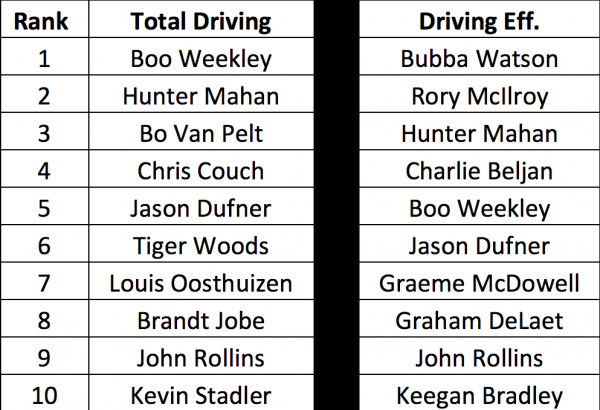
Here is a table showing the top-10 and bottom-10 players in Driving Effectiveness and the Total Driving metric.
Top-10 in Driving Effectiveness
Bottom 10 in Driving Effectiveness
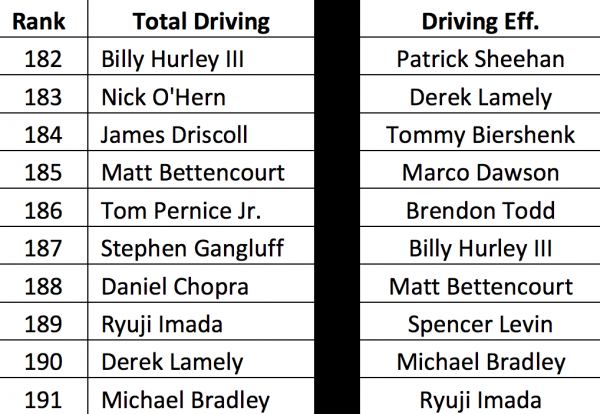
While there are some similarities between the rankings of the two metrics, there are plenty of players who are not accurately depicted in Total Driving. Here’s a look at the top-10 players who had the largest improvement in Driving Effectiveness ranking from the Total Driving metric.
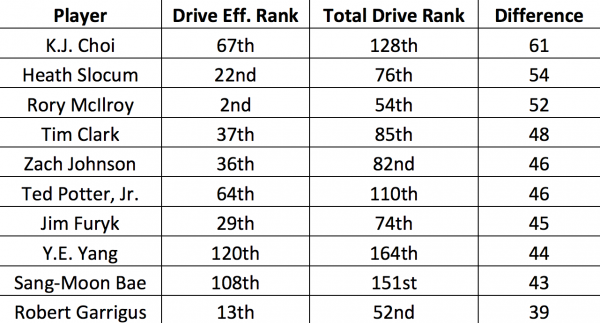
Here are the players with the largest decline in Driving Effectiveness ranking from the Total Driving metric.
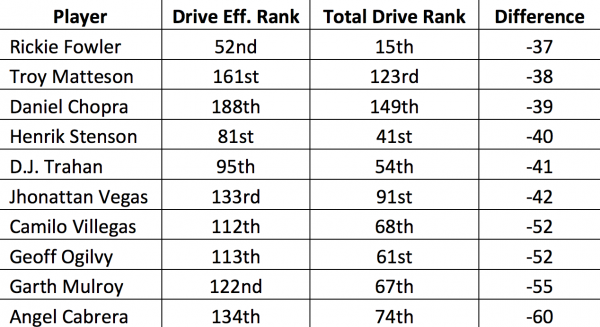
In golfers who had a much better Driving Effectiveness ranking, we see that favoring shorter hitters a little. Conversely, with the golfers with a worse Driving Effectiveness ranking, that has a small bias towards longer hitters. The reason being has to do with the Average Distance To The Edge of the Fairway metric.
However, the bias is somewhat small. I believe the reason for that is regardless of their length off the tee, Tour players do not typically see a sizeable difference in where they rank on Tour between fairway percentage and Average Distance to the Edge of the Fairway.
For example, KJ Choi saw the largest difference in Driving Effectiveness (67th) versus Total Driving (128th). Choi was ranked 54th in fairway percentage, hitting 64.08 percent of his fairways. But, Choi was also 2nd in Average Distance to the Edge of the Fairway, hitting it 18.7 feet from the edge on average. Thus, Choi was more effective than Total Driving indicates because when he did miss the fairway, he did not miss by much.
I think that amateurs can apply the general principles of Driving Effectiveness in their own game as well. If they are looking to become more effective off the tee, the ways to make the largest improvements would be to increase their driving distance (power) and their Distance to the Edge of the Fairway (precision). If they are looking at swing changes or a new driver in order to increase distance, they should focus more on how that may possibly affect their Average Distance To The Edge of the Fairway.
However, if they gain power but lose too much precision they may end up being less effective in the long run. And if they do not believe they can gain any power, they should probably focus their efforts on Fairway percentage (accuracy) and Distance To The Edge of the Fairway (precision) in order become more effective off the tee.



This past Monday, I played in the U.S. Amateur local qualifier at Rock Creek Country Club in Portland, Oregon. A full tee sheet from 7:30 a.m. to 1:55 p.m., the top 11 scores would make it to the U.S. Amateur final qualifying.
I teed off at 10:48 a.m.. With the 7:30 am tee time, you can get a feel for the leaders’ pace, and they were off and running on the challenging setup at Rock Creek.
View this post on Instagram
Getting to the highlight of the round on the par five 17th, a drive up the left side and 212 yards left to the front hole location. I took out a 5-iron with plans of middle of the green. The ball ended up 8 feet left of the hole, pin high. A slight downhill putt dropped in for an eagle 3 on the 17th. With the cut line looking to be anywhere from -2 to even par. This was the boost I had been waiting for all day.
With making par from the trees on 18, it was time to wait for a potential playoff with a posted score of one under par 71.
Three hours later, it was playoff time. 8 players for 6 spots. I made par on the playoff hole, which was good enough to advance to the U.S. Amateur final qualifying in July. USGA qualifiers sure deliver on all of the emotions in golf!
Club Junkie
Building my 2026 gamer WITB: Ranking the contenders and new putter projects – Club Junkie Podcast


The annual What’s In The Bag build is underway, and on this episode of Club Junkie, Brian breaks down the clubs currently leading the race for a spot in his 2026 gamer setup. From drivers and fairway woods to irons, wedges, and shafts, he ranks the equipment that’s performing best and explains what’s separating the front runners from the rest of the field.
Brian also heads into the workshop to discuss several putter projects currently on the bench. From head options and shaft choices to build ideas and testing plans, he shares what he’s working on and which putters could become serious contenders for the bag this season.
If you’re a gear junkie who loves equipment testing, club building, and the never-ending pursuit of the perfect setup, this episode is for you.
Follow Club Junkie:
Instagram: @clubjunkiepod
TikTok: @clubjunkiepod
Threads: @clubjunkiepod
X: @ClubJunkiePod
Club Junkie
Tour Edge Exotics mini driver review + TaylorMade Spider ZT Max first look – Club Junkie


On this episode of Club Junkie, I put the new Tour Edge Exotics Mini Driver to the test and break down the performance, forgiveness, distance, and where it fits compared to a traditional driver or strong fairway wood. If you have been curious about adding a mini driver to the bag, this one is worth a look.
I also dive into the new TaylorMade Spider ZT Max putter that was recently spotted and discuss the growing zero torque putter trend. Plus, there is a closer look at the new Project X Titan Yellow shaft showing up on the PGA Tour and what makes it different from other profiles currently out there.

Justin Rose WITB 2026 (April): Full WITB breakdown with new McLaren irons

What’s the story behind Webb Simpson’s custom-stamped irons?

Cadillac Championship Tour Report: Spieth’s sizable changes, McLaren Golf launches, and more

Memorial Tournament Tour Report: Rory McIlroy, Cameron Young switch up drivers, and more

Russell Henley’s winning WITB: 2026 Charles Schwab Challenge

Kristoffer Reitan’s winning WITB: 2026 Truist Championship

Aaron Rai’s winning WITB: 2026 PGA Championship

Cameron Young’s winning WITB: 2026 Cadillac Championship

Details on Jason Day’s latest prototype Avoda iron setup

Nelly Korda WITB 2026 (April)


Alex Noren WITB 2026 (June)
Driver: Callaway Paradym Ai Smoke Max D (9 degrees @7, draw setting) Shaft: Graphite Design Tour AD VF 6 X 3-wood: Callaway...


Melanie Green WITB 2026 (June)
Driver: TaylorMade Qi4D (9 degrees) Shaft: Graphite Design Tour AD VF 5 S 3-wood: TaylorMade Qi4D (15 degrees) Shaft: Graphite Design Tour...


Sungjae Im WITB 2026 (June)
Sungjae Im had >14 clubs in his bag when photographed prior to the Memorial Tournament. Driver: Titleist TSi2 (8 degrees, B1...

Lucas Glover WITB 2026 (June)
Lucas Glover had >14 clubs in his bag when photographed prior to the Memorial Tournament. Driver: Titleist GTS2 (10 degrees, B2 SureFit...
-
 Equipment2 days ago
Memorial Tournament Tour Report: Rory McIlroy, Cameron Young switch up drivers, and more
-
 News7 days ago
Russell Henley’s winning WITB: 2026 Charles Schwab Challenge
-
 Whats in the Bag3 weeks ago
Aaron Rai’s winning WITB: 2026 PGA Championship
-
 Equipment4 days ago
Details on Jason Day’s latest prototype Avoda iron setup
-
 Tour Photo Galleries3 weeks ago
Photos from the 2026 CJ Cup Byron Nelson
-

 Equipment2 weeks ago
CJ Cup Byron Nelson Tour Report: Koepka and Kim’s newest putters finally get hot
-
 News1 week ago
Charles Schwab Challenge Tour Report: MacIntyre, Åberg and Spaun all switch putters, TaylorMade launches new Spider
-
 Equipment2 weeks ago
Details on J.J. Spaun’s surprise putter switch


Philip
Feb 8, 2013 at 11:19 am
Great article. Recently, I’ve become intrigued by the statistics of the game of golf and other sports.
be_right
Jan 5, 2013 at 10:23 am
Great article….Do you publish your driving effectiveness stats anywhere? I’d love to follow along throughout the season.
stevielee
Nov 29, 2012 at 12:50 am
i disagree with The Pecker, this author somehow simply showed his approach and explained his findings without all the science behind it. now i can understand that even somedays that i couldnt hit single fairway and still had a decent day at the course. this is what you should get from an short online article.
Richie Hunt
Nov 15, 2012 at 5:00 pm
Hello,
I agree with many of your points, except for the last one stating that I am ‘fond of rendering the reader unable to form their own opinion.’
The difficult part for me is that I utilize a proprietary statistical model that took time, effort and mathematical knowledge to create. Thus, giving it away for free is not something I am willing to do.
This is not all that uncommon. I know the advanced metrics group for NFL research, Football Outsiders and Pro Football Focus, do not give away their models and algorithms either. But they present the information and their findings to their readers and then the readers decide how much sense it makes. This does typically lead to some debate as to how good certain players and teams are along with debating certain aspects and strategies of the game. But, they have obviously allowed their readers to render their own opinions because they have plenty of readers with plenty of opinions.
I think in this article, the reader can render some opinion on the importance of the Avg. Distance to the Edge of the Fairway metric along with the flawed nature of Total Driving from a basic mathematical standpoint and whether or not the metrics should be weighted evenly or disproportionally. The reader could also discern if a players I listed like KJ Choi, Rory McIlroy and Robert Garrigus are better or worse than their Total Driving metric indicates. If you have further questions, please let me know.
The Pecker
Nov 15, 2012 at 2:46 pm
While I think it is appropriate to incorporate more data into driving efficiency, I am unable to accept the author’s data for one simple reason. The author criticizes the PGA Tour for their “total driving” forumla, whereas, in the author’s analysis, they avoid mentioning any formula, rendering the reader unable to form their own opinion – something the author is clearly fond of doing.