
Instruction
The Plane Truth about Swings and Things

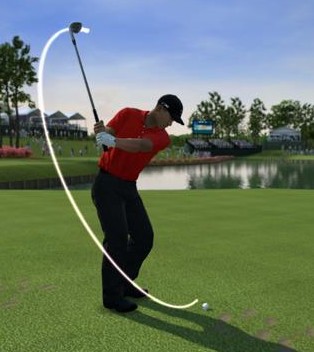
In his book, The Plane Truth for Golfers instructor Jim Hardy says there are at least two ways to swing the golf club:
- Around the body
- Up and down out in front of the body
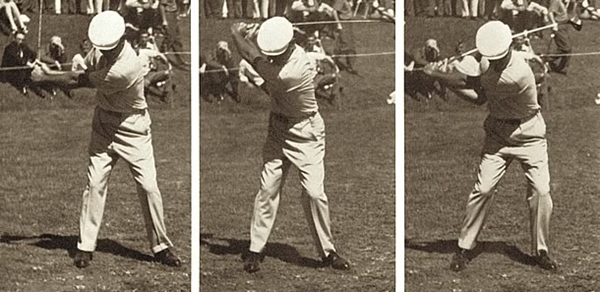
He labels these swings “one-plane” and “two-plane,” respectively. Ben Hogan was a classic one planer, and Tom Watson was a two planer. I think the book is well worthy of discussion, and possibly much more. Personally, I have great respect for Jim Hardy — he taught us a lot through the years, and The Plane Truth for Golfers, in particular, can be a great help to many players.
There have been thousands of books written on how to play and swing. Most of them suggest a method — one way of swinging the golf club to hit the ball. What is new and noteworthy about Hardy’s work is he is recommending two distinct motions guided by two separate sets of fundamentals.
For so long we have heard about “the fundamentals.” When I was learning the game, I was curious about fundamentals because I saw many of the leading professionals with different grips, stances, backswings, etc. I always wondered what “fundamentals” those books were talking about. What is standard; what is right?
Well, it didn’t take me long before I figured out there was more than one way to swing. John Jacobs once said,
“The purpose of the golf swing is to reach good solid impact; the method employed is of no consquence, as long as it is repetitive.”
So we have known for some time there are different routes to solid golf shots. But Jim Hardy has actually quantified these diverse styles and describes them in detail in his book. So let’s take a look. I am not going to detail the book, you’ll have to read it for that, but I am going to discuss the theory behind it.
In the book, Hardy uses the analogy of a tire (I have also heard him use a hula hoop as an example). Let’s say the tire or hula hoop is standing up, as it would on your car for example, at 90 degrees to the ground. Very little of the tire is touching the ground. The circle represented by the tire or hula hoop has a very narrow bottom. This is like an upright golf swing. It has a very narrow bottom, and it is “in and out of” the ground quickly, spending a very short time along the turf.
Now take that tire or hula hoop and tilt it down. You’ll notice that a lot more of the circle is touching or very close to the ground. It is along the ground a longer time. This is the idea behind a flat golf swing. It is wider than an upright one, parallelling the ground for a greater area. The upright, narrow swing is quite steep — the flatter, wider swing is shallow (ariving at low point sooner).
OK, so we have upright = steep, and narrow and flat = shallow and wide. Got that?
Secondly, the golf swing is powered by the body in the one-plane swing and by the arms and club in the two-plane swing. It’s important to get these points because THEY ARE THE BASIS OF THE WHOLE BOOK. Everything Hardy suggests for you to do is based on these concepts. If you swing the club flat, you need certain fundamentals, and if you swing the club upright the fundamentals change. If we go through all the recommended swing and set up positions, you will see that they are designed to facilitate the two basic swing ideas.
One-plane setup recommendations
- Grip: Strong(ish), 3 knuckles.
- Stance: A little wider than normal and a little further from the ball with the left foot out.
- Posture: More bent at the waist with shoulders outside the toe line and the spine centered (no upper body axis tilt).
- Aim: Square to slightly closed.
Two-plane setup recommendations

- Grip: Neutral to slightly weak, 2 knuckles at most.
- Stance: A little narrower with the feet inside your shoulders and a square left foot.
- Posture: More erect with your shoulders over toes and a slight tilt to the right.
- Aim: Square to slightly open.
Now the key question: Why the differences?
Well, remember the two swings and keep these points in mind: In the one-plane swing, the stronger grip promotes a slightly closed club face, which has a steepening effect on the swing. This balances the natural flatness of the one-plane swing (Note: Jim hardy is all about balance, one position offsets another).
The wider stance in the one-plane swing keeps the body more centered, which balances the width of the one-plane swing (if you’re creating width with the arms, the body cannot get off the ball — that’s two wides!).
The more bent posture for one-plane swing allows the shoulders to turn steeper (read narrower), which balances the flatness (read width) of the arm swing. And the slightly closed aim allows the club to work in and behind, which balances the resistance of the upper body.
In the two-plane swing, the slightly weaker grip allows for an open face and an open face has a flattening effect on swing angles, which balances the upright action. The narrower stance allows the body to move more off the ball. That creates body width, which balances the narrowness of the upright arm swing. The more upright posture in the two-plane swing allows the shoulders to turn flatter, which balances the vertical swing action. And finally the more open aim allows the club to work back a little straighter, which balances the freer turn with the upper body.
So it’s all about balance — one move offsets another, one motion complements another. Yes, you can center your pivot, but you need a wide swing to complement it. Yes, you can move your center but you need a narrower swing; so on and so forth.
As for the swing itself, chapters 3 and 4 (pages 30-110 in the book) detail the motions with considerable illustrations. I will make a few general references about the swing acton here: In a one-plane swing, the club swings in and around with the right elbow going behind the golfer and the left arm staying close to the chest, producing a plane quite similar to the shoulders. The shoulders are turning against a stable lower body, creating coil in the upper body. From the top, the TORSO begins the downswing; remember, the trunk is the power move here and the golf club is behind you, so you must unwind the torso first or it is easy to “get stuck.” The death move in the one-plane swing is a tilt of the shoulders from the top, as it will surely drop the club behind you.
Now in the two-plane swing, the shoulders have turned on a much flatter plane, and the arms have swung on a more vertical plane up OVER you, not behind you. From the top, the shoulders remain passive and the arms (the motor of the two-plane swing) separate immediately from the shoulders, swinging aggressively down to the ball. The hips begin with a LATERAL move toward the target, as getting “stuck” is not as much a concern because the arms are more over and out in front you. After the initial lateral move, the hips and torso turn AS THE ARMS AND CLUB SWING DOWN. As I said, this paints a very general picture of the motions. I highly recommend reading chapters 4 and 5 in the book. But if you read the book, be aware of two things: Swing width and the compatible fundamentals.
The point is this: BOTH WAYS ARE EFFECTIVE, but you cannot randomly choose a set-up position when deciding which swing is for you. Personally, if I were forced to choose, I think the one-plane swing is more consistent, but it does demand more physicality than the free swinging action of the two-plane swing.
Take a look through the book. See where you stand or where you’d like to go, and consider the recommendations for each. I think Jim Hardy is a great teacher who has given us much to think about in this seminal work. Also, Hardy allows and I agree that there are “hybrid” swings, many of them, but these blended efforts are still governed by the starting positions that put them in motion.
I said in my last article about Ben Hogan’s instruction book, Five Lessons: The Modern Fundamentals of Golf that while I believed the information was great, the points in the book were harmful to the vast array of weekend warriors. Jim Hardy’s book is a much more universal prescription that can help everybody.
As always, feel free to send a swing video to my Facebook page and I will do my best to give you my feedback.
Click here for more discussion, and to ask Dennis a question in the “Instruction & Academy” forum.
- LIKE75
- LEGIT12
- WOW2
- LOL4
- IDHT1
- FLOP1
- OB2
- SHANK6




My golf learning began with this simple fact – if you don’t have a fundamentally sound hold on the golf club, it is practically impossible for your body to execute a fundamentally sound golf swing. I’m still a big believer that the golf swing is much easier to execute if you begin with the proper hold on the club.
As you might imagine, I come into contact with hundreds of golfers of all skill levels. And it is very rare to see a good player with a bad hold on the golf club. There are some exceptions, for sure, but they are very few and very far between, and they typically have beat so many balls with their poor grip that they’ve found a way to work around it.
The reality of biophysics is that the body moves only in certain ways – and the particulars of the way you hold the golf club can totally prevent a sound swing motion that allows the club to release properly through the impact zone. The wonderful thing is that anyone can learn how to put a fundamentally sound hold on the golf club, and you can practice it anywhere your hands are not otherwise engaged, like watching TV or just sitting and relaxing.
Whether you prefer an overlap, interlock or full-finger (not baseball!) grip on the club, the same fundamentals apply. Here are the major grip faults I see most often, in the order of the frequency:
Mis-aligned hands
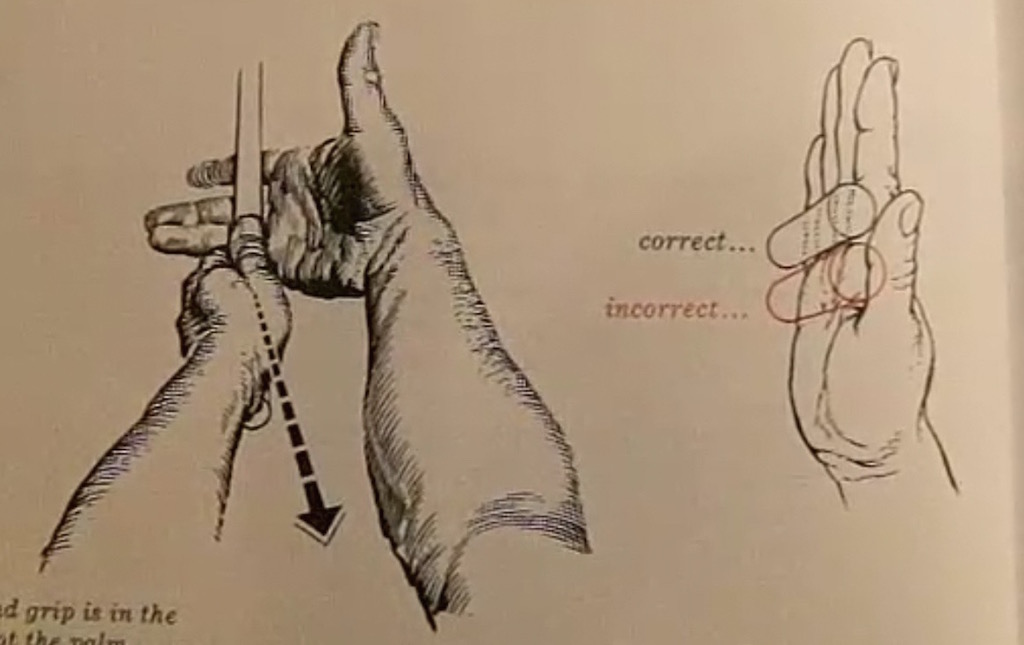
By this I mean that the palms of the two hands are not parallel to each other. Too many golfers have a weak left hand and strong right, or vice versa. The easiest way to learn how to hold the club with your palms aligned properly is to grip a plain wooden ruler or yardstick. It forces the hands to align properly and shows you how that feels. If you grip and re-grip a yardstick several times, then grip a club, you’ll see that the learning curve is almost immediate.
The position of the grip in the upper/left hand
I also observe many golfers who have the butt of the grip too far into the heel pad of the upper hand (the left hand for right-handed players). It’s amazing how much easier it is to release the club through the ball if even 1/4-1/2″ of the butt is beyond the left heel pad. Try this yourself to see what I mean. Swing the club freely with just your left hand and notice the difference in its release from when you hold it at the end of the grip, versus gripping down even a half inch.
To help you really understand how this works, go to the range and hit shots with your five-iron gripped down a full inch to make the club the same length as your seven-iron. You will probably see an amazing shot shape difference, and likely not see as much distance loss as you would expect.
Too much lower (right) hand on the club
It seems like almost all golfers of 8-10 handicap or higher have the club too far into the palm of the lower hand, because that feels “good” if you are trying to control the path of the clubhead to the ball. But the golf swing is not an effort to hit at the ball – it is a swing of the club. The proper hold on the club has the grip underneath the pad at the base of the fingers. This will likely feel “weak” to you — like you cannot control the club like that. EXACTLY. You should not be trying to control the club with your lower/master hand.
Gripping too tightly
Nearly all golfers hold the club too tightly, which tenses up the forearms and prevents a proper release of the club through impact. In order for the club to move back and through properly, you must feel that the club is controlled by the last three fingers of the upper hand, and the middle two fingers of the lower hand. If you engage your thumbs and forefingers in “holding” the club, the result will almost always be a grip that is too tight. Try this for yourself. Hold the club in your upper hand only, and squeeze firmly with just the last three fingers, with the forefinger and thumb off the club entirely. You have good control, but your forearms are not tense. Then begin to squeeze down with your thumb and forefinger and observe the tensing of the entire forearm. This is the way we are made, so the key to preventing tenseness in the arms is to hold the club very lightly with the “pinchers” — the thumbs and forefingers.
So, those are what I believe are the four fundamentals of a good grip. Anyone can learn them in their home or office very quickly. There is no easier way to improve your ball striking consistency and add distance than giving more attention to the way you hold the golf club.
More from the Wedge Guy
- The Wedge Guy: Golf mastery begins with your wedge game
- The Wedge Guy: Why golf is 20 times harder than brain surgery
- The Wedge Guy: Musings on the golf ball rollback
- LIKE82
- LEGIT13
- WOW4
- LOL1
- IDHT0
- FLOP4
- OB1
- SHANK8

Not the dreaded headcover under the armpit drill! As if your body is defective and can’t function by itself! Have you seen how incredible the human machine is with all the incredible feats of agility all kinds of athletes are accomplishing? You think your body is so defective (the good Lord is laughing his head off at you) that it needs a headcover tucked under the armpit so you can swing like T-Rex?
- LIKE0
- LEGIT1
- WOW2
- LOL0
- IDHT0
- FLOP0
- OB0
- SHANK2

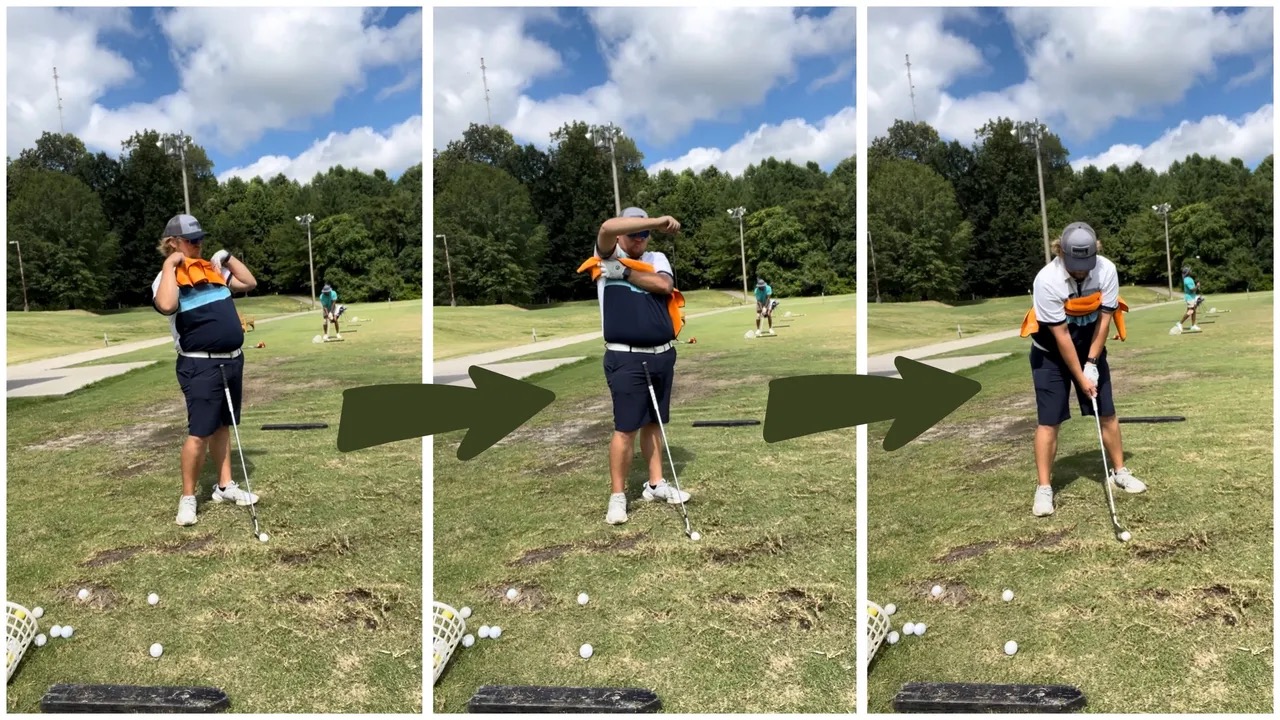
This is a classic drill that has been used for decades. However, the world of marketed training aids has grown so much during that time that this simple practice has been virtually forgotten. Because why teach people how to play golf using everyday items when you can create and sell a product that reinforces the same thing? Nevertheless, I am here to give you helpful advice without running to the nearest Edwin Watts or adding something to your Amazon cart.
For the “scoring clubs,” having a solid connection between the arms and body during the swing, especially through impact, is paramount to creating long-lasting consistency. And keeping that connection throughout the swing helps rotate the shoulders more to generate more power to help you hit it farther. So, how does this drill work, and what will your game benefit from it? Well, let’s get into it.
Setup
You can use this for basic chip shots up to complete swings. I use this with every club in my bag, up to a 9 or 8-iron. It’s natural to create incrementally more separation between the arms and body as you progress up the set. So doing this with a high iron or a wood is not recommended.
While you set up to hit a ball, simply tuck the towel underneath both armpits. The length of the towel will determine how tight it will be across your chest but don’t make it so loose that it gets in the way of your vision. After both sides are tucked, make some focused swings, keeping both arms firmly connected to the body during the backswing and follow through. (Note: It’s normal to lose connection on your lead arm during your finishing pose.) When you’re ready, put a ball in the way of those swings and get to work.
Get a Better Shoulder Turn
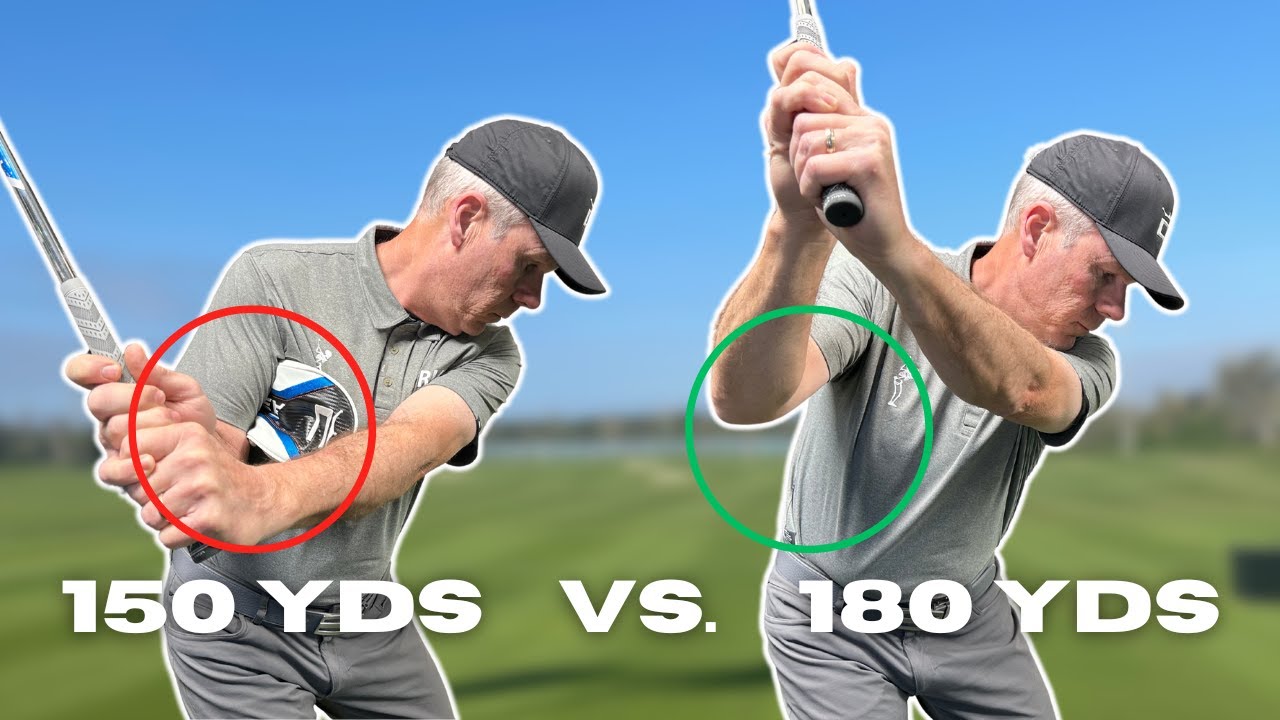
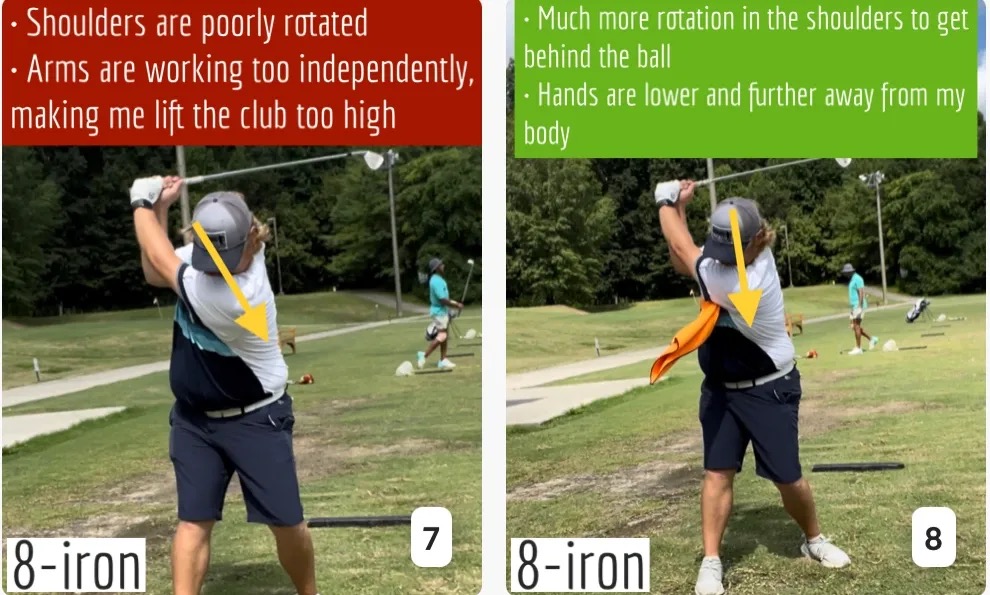
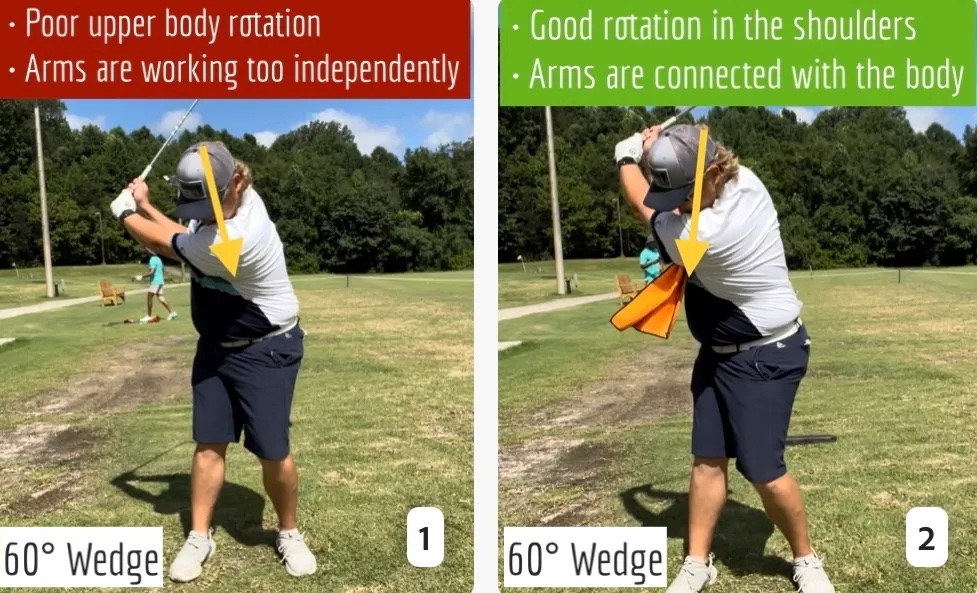
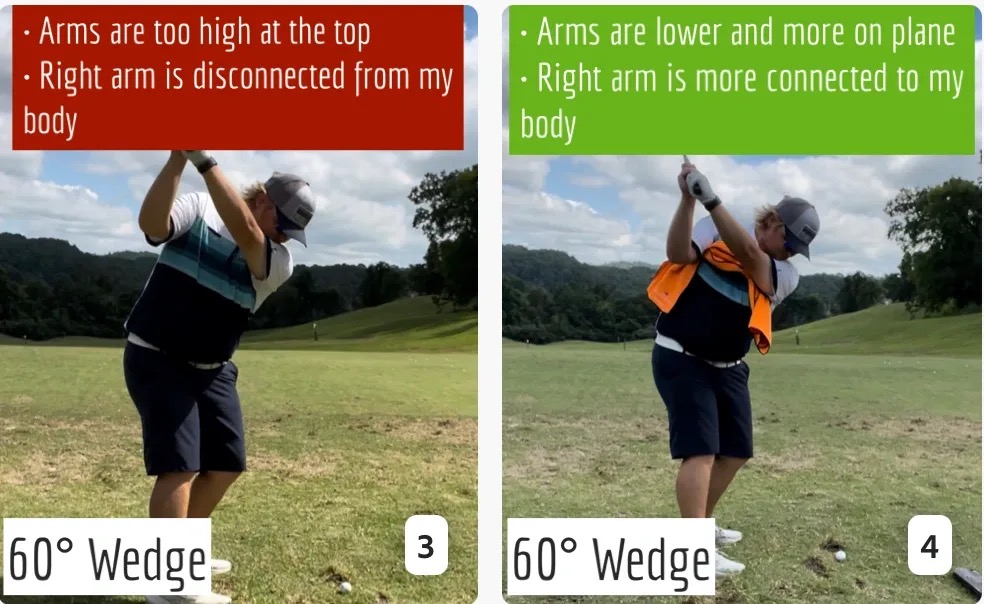
Many of us struggle to have proper shoulder rotation in our golf swing, especially during long layoffs. Making a swing that is all arms and no shoulders is a surefire way to have less control with wedges and less distance with full swings. Notice how I can get in a similar-looking position in both 60° wedge photos. However, one is weak and uncontrollable, while the other is strong and connected. One allows me to use my larger muscles to create my swing, and one doesn’t. The follow-through is another critical point where having a good connection, as well as solid shoulder rotation, is a must. This drill is great for those who tend to have a “chicken wing” form in their lead arm, which happens when it becomes separated from the body through impact.
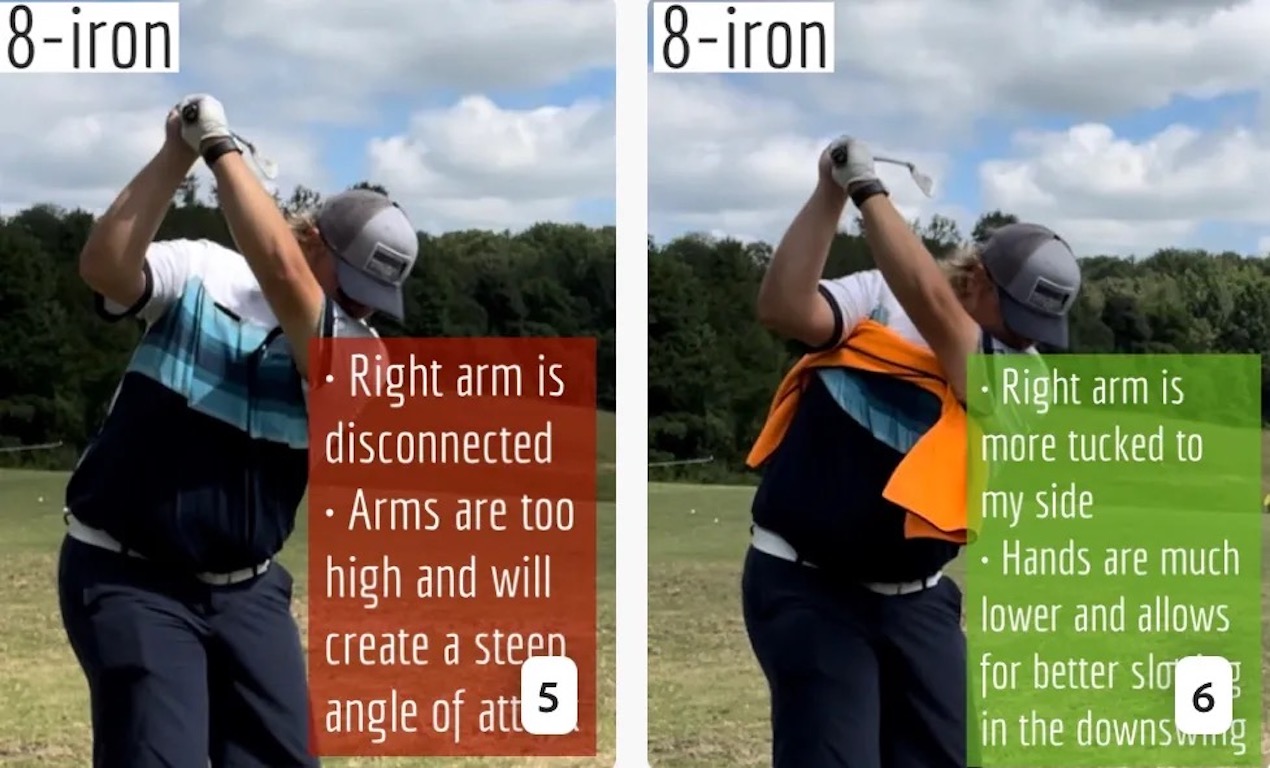
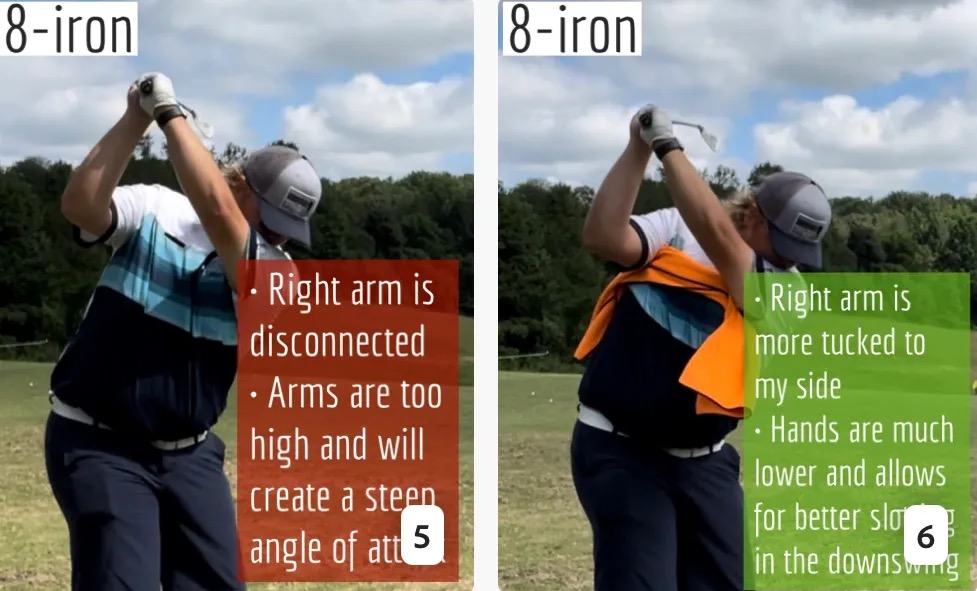
In full swings, getting your shoulders to rotate in your golf swing is a great way to reinforce proper weight distribution. If your swing is all arms, it’s much harder to get your weight to naturally shift to the inside part of your trail foot in the backswing. Sure, you could make the mistake of “sliding” to get weight on your back foot, but that doesn’t fix the issue. You must turn into your trial leg to generate power. Additionally, look at the difference in separation between my hands and my head in the 8-iron examples. The green picture has more separation and has my hands lower. This will help me lessen my angle of attack and make it easier to hit the inside part of the golf ball, rather than the over-the-top move that the other picture produces.
Stay Better Connected in the Backswing
When you don’t keep everything in your upper body working as one, getting to a good spot at the top of your swing is very hard to do. It would take impeccable timing along with great hand-eye coordination to hit quality shots with any sort of regularity if the arms are working separately from the body.
Notice in the red pictures of both my 60-degree wedge and 8-iron how high my hands are and the fact you can clearly see my shoulder through the gap in my arms. That has happened because the right arm, just above my elbow, has become totally disconnected from my body. That separation causes me to lift my hands as well as lose some of the extension in my left arm. This has been corrected in the green pictures by using this drill to reinforce that connection. It will also make you focus on keeping the lead arm close to your body as well. Because the moment either one loses that relationship, the towel falls.
Conclusion
I have been diligent this year in finding a few drills that target some of the issues that plague my golf game; either by simply forgetting fundamental things or by coming to terms with the faults that have bitten me my whole career. I have found that having a few drills to fall back on to reinforce certain feelings helps me find my game a little easier, and the “towel drill” is most definitely one of them.
- LIKE12
- LEGIT1
- WOW2
- LOL0
- IDHT0
- FLOP2
- OB0
- SHANK8


The Wedge Guy: Golf mastery begins with your wedge game

Tour pro calls Anthony Kim a ‘f*****g idiot’ following Instagram comeback post

John Daly stuns fans into silence with brutal opening tee shot on PGA Tour Champions

Things got heated at the Houston Open between Tony Finau and Alejandro Tosti. Here’s why

Anthony Kim WITB 2024 (February)

This Rory McIlroy post-round ‘The Match’ moment is going viral…but all is likely not what it seems

Scottie Scheffler WITB 2024 (March)

Photos from the 2024 Arnold Palmer Invitational

Anthony Kim’s speculated LIV Golf sign-on fee may surprise you

The total sum that Sergio Garcia needs to pay in fines if he wants to return to DP World Tour revealed

Raul Pereda WITB 2024 (April)
Raul Pereda what’s in the bag accurate as of the Texas Children’s Houston Open. More photos from the event here....


Rickie Fowler WITB 2024 (April)
Rickie Fowler what’s in the bag accurate as of the Valero Texas Open. More photos from the event here. Driver: Cobra...

Callum McNeill WITB 2024 (April)
Callum McNeill what’s in the bag accurate as of the Texas Children’s Houston Open. More photos from the event here....

Jimmy Stanger WITB 2024 (April)
Jimmy Stanger what’s in the bag accurate as of the Valero Texas Open. More photos from the event here. Driver:...
-
 19th Hole1 week ago
John Daly stuns fans into silence with brutal opening tee shot on PGA Tour Champions
-
 19th Hole3 days ago
Things got heated at the Houston Open between Tony Finau and Alejandro Tosti. Here’s why
-
 19th Hole2 weeks ago
2-time major champ announces shock retirement from the sport at age of 33
-

 19th Hole1 week ago
Charlie Woods finds it tough going on American Junior Golf Association debut
-
 19th Hole2 weeks ago
Edoardo Molinari reveals the latest PGA Tour golfer to turn down ‘good offer’ from LIV Golf
-
 19th Hole2 weeks ago
Scottie Scheffler had an interesting response when asked how he ‘quiets the noise’ following Players victory
-
 19th Hole2 weeks ago
Jon Rahm dealt fresh blow to hopes of qualifying for 2025 Ryder Cup
-
 19th Hole2 days ago
Addiction, spinal fusion, and scam artists – Everything Anthony Kim revealed in candid interview with David Feherty


Bernard Sullivan
Feb 6, 2019 at 10:32 am
I played one plane swing by mistake,as I started of 2 plane,and just picked it up on the range,as I was bending over more, trying it get an angle in to do a draw shot, anyway I became very armsy and rotating the body around me,but I lacked distance,and my back started hurting after a while,so I’ve gone back to 2 plane,but the problem I have now is, on the takeaway I keep bringing the club low and along the ground,and then swinging around and behind,and either hit the ground or just goes out right,I’ve totally lost the correct swing path,but now I realized you have to lift the club and turn in the two plane,but I can’t seem to do consistently,but when I do it right I hit the ball miles and seems like I hardly moved,but I do remember getting up high in the takeaway,can anyone give me a good tip to get the club up,and not keep sloping back into low and bringing club across instead of up and over me,it’s doing my head in,I only had 3 lessons in my life and that was only with a 7 iron,and I got an 18 handicap,but I play more like a 28, please, many thanks,
Jason
Feb 20, 2020 at 10:41 pm
Try taking some practice swings with your heels about 6-8 inches from a wall behind you, this will not allow the club to get behind your body. The goal is to make a back swing without hitting the wall.
Dan
Apr 4, 2014 at 10:01 am
Interested in getting more info on the “2 Plane Swing”
How does this book compare to the “LAWS of Golf” by Suttie, Tomasi, Adams? I found this book to be a game changer once I starting working on the “Arc” method.
Was difficult to learn the “hip bump/move down” , how is this book in explaining that?
Minh Nguyen
Mar 31, 2014 at 12:34 pm
Dennis, have you heard of the Haney Blueprint? I watched the infomercial and he talked about a “Parallel Plane”. How does that compare or contrast to a single or two plane swing?
Dennis Clark
Mar 31, 2014 at 4:33 pm
His concept is more of a one plane one. He likes the golf club parallel to the original shaft plane throughout the swing. IOW, same angle different points of origin. Like so many things- good for some not for others…For average golfers, i prefer more of a one plane swing simply because it’s easier to square the face
tom stickney
Mar 31, 2014 at 10:56 am
Good article Dennis…I’m asked the same thing on the lesson tee on a weekly basis.
All the best.
Dennis Clark
Mar 31, 2014 at 4:29 pm
Thx Tom, you know how it is! 🙂
Martin
Jan 3, 2013 at 6:47 pm
Ok, thank you! BTW, I love reading your articles and I am learning a lot, like your approach in the articles, to sort of tell us things we dont read in the articles or the books. I am trying to get a two plane motion to work, so thanks for the input on that!
Martin
Jan 2, 2013 at 1:12 pm
Very interesting article. You mention that the one plane swing requires more of psycical ability than the two plane swing. In what way? Are you talking about strength and flexibility or coordination?
Thank you!
Dennis Clark
Jan 2, 2013 at 6:56 pm
I think it has more to do with the body and the ability to rotate. So yes more flexibility ansd strength. It is a body dominated motion so to speak. Thx DC
bob
Dec 26, 2012 at 5:10 pm
YEA AND HOGAN’S FACE WAS OPEN AS WELL> I thought your ONE PLANNER was meant to have a closed clubface as well.
Dennis Clark
Dec 26, 2012 at 6:18 pm
Hardy is saying the same thing as you. There are a lot of ways to swing the club, and they must complement the fundamentals you choose-much like the great players to whom you refer. Hogan was a one planer swing who employed a WEAK grip for one reason-to FADE the ball. Tell a student to do that and look quickly to the right for the ball flight. And what Hogan could do most couldn’t.
Richard Montfort
Dec 18, 2012 at 3:59 pm
Powerful Golf Concept part 1/2
Powerful Golf Concept part 2/2
on you tube
ac930
Dec 14, 2012 at 12:05 am
Jim Hardy is the man! Unbelievable how great his instruction is. He didn’t invent the methods, he simply figured it out. I suggest you watch all his DVD’s
andrew cooper
Dec 12, 2012 at 2:12 pm
Thanks Dennis, interesting article on The Plane Truth. I’m a fan of Hardy, but have always felt the major flaw in his one plane or two plane idea is that in reality nearly every golfer, including the great ones, have elements of both-the “hybrids”. So basically, one plane, two plane or a combo??!! it kind of doesn’t matter.